


Corrective Action and Documentation
Poor performance or bad behavior on the job can take many forms. It is ultimately the supervisor’s job to identify and then try to modify the undesirable performance or behavior of the employee so that it is in compliance with expectations. That, in a nutshell, is corrective action.
In the workplace we typically use a verbal or written warning or counseling to communicate to the employee what he/she is doing wrong; what needs to be done to correct the problem; and what will happen if the problem is not corrected.
Verbal Counseling
Verbal counseling is to be used when an employee initially fails to meet behavioral and/or performance standards. An employee’s continued employment should not be threatened at this stage. Do your fact finding first. This includes talking to the employee to get his/her side of the story before you give any kind of warning. The verbal counseling should include, behavior/performance that is unacceptable, positive suggestions for improvement, and consequences to productivity or performance of failure to correct problem. Try to find out why the employee's performance or behavior is unacceptable and help the employee plan for a change. Do not give the employee a written document for a verbal counseling. You may document that you gave the counseling in your notes. You should have talking points that you use to speak to the employee to ensure that you stay on point and these talking points will serve as your documentation that the counseling occurred. It may be of limited value as documentation but if the verbal counseling changes behavior then you have accomplished your goal.
Written Warnings
The written warning has two purposes. It is used to communicate with the employee so that, hopefully, the performance or behavior will be improved. It also provides documentation so that should the employee not change his/her performance or behavior and then termination of employment occurs, the university will be able to demonstrate that the termination occurred solely because of the employee's failure to meet expectations rather than any nefarious motive that may be alleged by the terminated employee.
A written warning is to be used for a more serious offense or when the response to a verbal counseling is not sufficient. You do not necessarily have to give a verbal counseling before you can give a written warning. Do your fact finding first. This includes talking to the employee to get his/her side of the story before you give any kind of warning. Do not give an employee the written warning at the same meeting in which you do fact finding. Use the “What if I got it” test. Does it make sense, is it appropriate? It may be necessary in a written warning to make it clear to the employee that his/her continued employment may be in jeopardy if the appropriate response is not made to the written warning. Review the written warning for tone (do not get personal), content (do not bring up a laundry list of the employee’s sins), clarity (will it make sense if read by an outsider?), and value. It must be signed by all parties and then it has great value both as a behavior modifier as well as documentation. Have the written warning reviewed by HR or your manager.
If you have an employee whose performance/behavior does not meet expectations, what do you do? You take corrective action and when taking corrective action with employees, your job as a manager is to use the skill and expertise necessary to effectively change the employee's behavior/performance, and to make sure our actions are such that risk to the university is minimized. This risk is minimized by documenting what you are doing so that later a more evil motive cannot be attributed to your action(s).
Points to Consider on Documentation
- Just do it. Juror attitude studies have shown that juries believe “if it isn't written down, it didn’t happen!”
- Just do it timely. If you are going to praise or reprimand it must be done in close proximity to the event that precipitated the praise or reprimand or the effect is diminished significantly. Acting in a timely manner is critical.
- The goal is to change behavior (the documentation is a byproduct of pursuing that goal). The documentation is essential from a legal perspective, but if you are successful in changing behavior and no further action is necessary there will be no legal perspective with which to deal.
- If you are going to have any potential for success in changing behavior you must successfully communicate to that employee: a) what he/she is doing wrong, i.e. the difference between expectations and actual performance; b) what he/she needs to do to do it right; and c) what will happen if he/she does not make the necessary corrections (this could be either a statement of potential outcomes related to the performance/behavior or it could be sanctions that may be taken, or both). Thus a document that covers the above (a–c) will be a good source to illustrate that whatever employment action was taken was taken for legitimate reasons.
- Do not put anyone on “Probation” or use the term probation. Probation, as used in written warnings, typically has a beginning and an end. That is not what you want. You want to express to the employee that the performance/behavior improvement must be “immediate and continued.”
- Always end by expressing confidence that the employee can change his/her behavior/performance and you are willing to help as long as he/she tries.
- Be sure that you initial or sign the document and if possible have the employee do so as well.
Employee or Independent Contractor
Samford University pays a large number of people as independent contractors every month. These people perform a wide variety of services for the university. It is important that we always ensure that the status of these persons as an independent contractor is accurate. How does a person acquire independent contractor status? It is not because we choose to designate them as such; it is not because they want to be designated as such. It is solely because they meet the definition of independent contractor as defined by the Internal Revenue Service. The IRS has an interest in this because independent contractors do not pay their taxes on a payroll deduction basis; they have to file and pay their taxes quarterly. Actual employees, on the other hand, pay taxes as they go on a payroll deduction basis. Therefore, the IRS does take an interest if they feel that people are being defined incorrectly as independent contractors.
Below is a review from the Internal Revenue Service's website of an independent contractor versus an employee.
“Whether someone who works for you is an employee or an independent contractor is an important question. The answer determines your liability to pay and withhold federal income tax, social security and Medicare taxes, and federal unemployment tax.
In general, someone who performs services for you is your employee if you can control what will be done and how it will be done.
It is critical that you, the employer, correctly determine whether the individuals providing services are employees or independent contractors. Generally, you must withhold income taxes, withhold and pay Social Security and Medicare taxes, and pay unemployment tax on wages paid to an employee. You do not generally have to withhold or pay any taxes on payments to independent contractors.
Caution: If you incorrectly classify an employee as an independent contractor, we (Samford University) can be held liable for employment taxes for that worker, plus a penalty.
Who is an independent contractor? A general rule is that you, the payer, have the right to control or direct only the result of the work done by an independent contractor, and not the means and methods of accomplishing the result.
Who is an employee? Under common-law rules, anyone who performs services for you is your employee if you can control what will be done and how it will be done. This is so even when you give the employee freedom of action. What matters is that you have the right to control the details of how the services are performed.
To determine whether an individual is an employee or independent contractor under the common law, the relationship of the worker and the business must be examined. All evidence of control and independence must be considered. In an employee-independent contractor determination, all information that provides evidence of the degree of control and degree of independence must be considered.
Facts that provide evidence of the degree of control and independence fall into three categories, behavioral control, financial control and the type of relationship of the parties.
Behavioral Control
Facts that show whether the business has a right to direct and control.
- Instructions—an employee is generally told:
- When, where and how to work
- What tools or equipment to use
- What workers to hire or to assist with the work
- Where to purchase supplies and services
- What work must be performed by a specified individual
- What order or sequence to follow
- Training—an employee may be trained to perform services in a particular manner.
Financial Control
Facts that show whether the business has a right to control the business aspects of the worker’s job include:
- The extent to which the worker has un-reimbursed expenses
- The extent of the worker’s investment
- The extent to which the worker makes services available to the relevant market
- How the business pays the worker
- The extent to which the worker can realize a profit or loss
Type of Relationship
Facts that show the type of relationship include:
- Written contracts describing the relationship the parties intended to create
- Whether the worker is provided with employee-type benefits
- The permanency of the relationship
- How integral the services are to the principal activity
For a worker who is considered our employee, we are responsible for:
- Withholding federal income tax
- Withholding and paying the employer social security and Medicare tax
- Paying federal unemployment tax (FUTA)
- Issuing Form W-2, Wage and Tax Statement annually
- Reporting wages on Form 941, employer’s quarterly federal tax return.
Job Description Guidelines
A job description is a summary of the primary duties, responsibilities, and requirements of a position. It is not intended to include every task an employee may perform. Job descriptions should reflect the position as it exists today, not as it may evolve in the future.
By following the guidelines below, you can create job descriptions that are accurate, consistent, and effective tools for hiring, employee development, and departmental/organizational planning.
Purpose
Job descriptions serve several important purposes:
- Define the primary responsibilities and requirements of a position.
- Help employees clearly understand their role and expectations.
- Support job evaluation, compensation review, and career development.
- Provide accurate information for internal and external job postings.
- Establish performance expectations and support employee growth and success.
Writing Guidelines
When drafting a job description, please follow these best practices:
- Use the University-approved template. Consistent formatting across all Samford University job descriptions helps ensure clarity, accuracy, and compliance.
- Keep language clear and concise. Use simple sentence structure and include only information that is necessary and relevant.
- Begin statements with action verbs. Examples may include analyze, approve, assist, authorize, coordinate, develop, evaluate, initiate, input, manage, operate, organize, perform, recommend, review, schedule, etc.
- Choose verbs that accurately reflect the role. For example, avoid using "manage" for a support position when terms such as "administer," "coordinate," or "initiate" are more appropriate. Helpful Tip: Use manage when the position is accountable for overseeing employees, programs, or processes. If the role primarily supports, coordinates, or carries out activities rather than directing them, select a verb that better reflects that level of responsibility.
- Use examples when helpful. Specific examples can provide additional context and clarity.
- Use bullet point format rather than paragraph format for longer sections. When listing out duties/responsibilities/qualifications, this makes it easier to read.
- Write for a broad audience. Use clear, concise, non-technical language whenever possible.
- Be specific. Avoid vague statements. For example:
- Less effective: Assists with preparing reports.
- Better: Compiles monthly reports and distributes them to department leaders.
- Focus on essential functions. Emphasize the essential, core duties of the position rather than infrequent or minor tasks.
- Add physical requirements as applicable to the position. List anything that is remotely a possibility (i.e., Ability to work evenings, nights, weekends, or holidays as needed; Ability to occasionally lift and push boxes or office items weighing up to 15 pounds; Ability to traverse campus regularly; Ability to attend in person, virtual, and telephone meetings and to communicate clearly and verbal and in writing; Ability to travel occasionally as needed, etc.).
- Write in present tense. Describe what the position currently does, not what it did in the past or may do in the future.
- Consider the full scope of work. Include responsibilities that occur throughout the entire 12-month period, even if they are seasonal or cyclical.
- Remain objective. Describe the position itself, not the skills, traits, or accomplishments of a specific incumbent.
- Set realistic minimum qualifications. Education and experience requirements should reflect the actual needs of the position. Inflated requirements may unintentionally exclude qualified candidates.
- Review job descriptions often. This ensures that the job description accurately reflects the work being performed by the employee.
Performance Management
Valuing Excellence
Samford University values excellence. We are committed to creating and maintaining an environment that emphasizes the importance of recognizing work performance to our mission. This information applies to regular full time and part time staff. Excluded from this performance management and review process are faculty and adjunct faculty.
An ongoing communication process that involves both the employee and supervisor in:
- Identifying and describing job functions and relating them to the mission and goals of the university and/or the academic or administrative unit.
- Developing realistic and appropriate performance expectations.
- Giving and receiving feedback about performance.
- Writing and communicating the results of the performance review.
- Planning educational and developmental opportunities to sustain, improve or build on employee work performance.
Performance Expectations
Written statements describing what is expected of an employee on the job in terms of performance and behavior. At the least, employees should be advised of performance expectations when they are hired and every year at the performance review. Refer to the section Performance Management/Merit Pay Program for instructions on how to write performance expectations.
Pay for Performance
A method of rewarding employees based on their accomplishments and annual performance review. The theory is that there should be a correlation between the employee's performance review and the value of their salary increase.
Frequent and Timely Conversations
The foundation of an effective performance review and management process is frequent and timely communication. It is expected that supervisors will inform employees of job requirements and performance expectations and the manner in which employees' performance will be evaluated. The success of this process depends on the willingness of supervisors to complete an objective, accurate and constructive performance review and on the willingness of employees to respond favorably to constructive feedback and, when needed, to improve their performance.
The performance of employees is evaluated generally at the end of the introductory period and generally in each year thereafter.
Employee Self-Appraisal Form
This form may be used when desired and is self-explanatory. Under no circumstances should employees be asked to complete the aforementioned performance review form.
Performance Review Form
A written performance review is based on the employee’s overall performance in relation to his/her job expectations. It takes into account the employee's work behaviors and other established performance expectations. The written performance review is a legal document. It is also an official record of the employee's work performance, and may be considered in future employment decisions. In addition to the regular performance review described above, supervisors may initiate at any time a written counseling or warning to document and advise an employee of performance deficiencies. Please refer to the section on Corrective Action and Documentation.
Employee Comments
During the performance review process, employees are provided an opportunity to review, discuss and comment on the actual performance review document. The performance review form is signed by the supervisor and the employee. A copy is given to the employee and the original is sent to the official employee file maintained by human resources.
Appeals Process
Disagreements may arise over the written performance review. In the event an employee disagrees with any part of the written review, he/she may attach a supplemental, explanatory response. The response will become a part of the record. If the employee believes the performance review is not factually accurate, he/she may request a review by the supervisor, the next level of management, and/or intervention by the AVP of Human Resources.
Accountability
- The Vice Presidents are responsible for assuring that their direct reports implement the performance management and review process in their areas for all eligible employees.
- The AVP of Human Resources is responsible for monitoring and assuring the uniform and consistent application of this process.Supervisors and managers are responsible for coaching, counseling and providing timely and factual feedback to their employees and codifying the same in a written performance review.
Performance Appraisal
- Elevate Samford Performance Review Training Video
- Elevate Samford Non-Supervisory Staff Performance Review
- For use with staff who do not have supervisory responsibilities
- Elevate Samford Supervisory Staff Performance Review
- For use with staff who have supervisory responsibilities
- Employee Reflection Form
- Employee Reflection Completion Guide
Staff Employment Procedure
Hiring Overview
Samford University is an equal employment opportunity employer that actively seeks to attract, hire, and retain a high caliber diverse workforce comprised of employees whose talents and experiences best equip the University to accomplish its mission.
As such, the University is committed to providing a workplace that offers equal employment opportunity for all persons. Samford University will not discriminate against or harass any employee or applicant for employment because of race, color, ancestry, national origin, sex, disability, or age. With respect to religion and creed, as permitted by law, the university reserves the right to exercise discretion in employment decisions to employ persons whom the University believes share and will further the values and mission of the University.
These employment procedure guidelines are provided to assist hiring officials, search committees, and support staff, as they plan, initiate, and/or participate in the University's search and selection process. The goal is to hire the most qualified applicant for every job while minimizing risk to the University.
Much of this process involves anticipating next moves and taking actions in advance to initiate processes and meet staffing levels in your area. Please be aware of the process and plan accordingly.
Hiring Procedure
Every staff position, either replacement or new, must undergo a job review through Human Resources. A job cannot be posted nor an offer extended until this review is completed and approved. All hiring action is to take place through the university applicant tracking system (NEOED).
The following bullet-point summary of the initial hiring steps applies whether you are requesting a replacement or a new position. More detailed instructions for this process are found here.
- The process differs depending on whether an existing position is being filled with no changes, changes are being made to an existing position, or a new position is being requested.
- If changes are being requested to an existing position or a new position is being requested, the hiring manager will need to submit a Staff Position Approval Request as a prerequisite to submitting a requisition to NEOED for posting. Once this form reaches final approval, the hiring manager will then proceed to their NEOED Manager dashboard to submit a requisition.
If no changes are being requested to an existing position that is vacant and within your current budget, the hiring manager will proceed to their NEOED Manager dashboard to submit a requisition.
START HERE IF..
You are creating a new position or making changes to an existing position.
Submit a STAFF POSITION APPROVAL REQUEST. After the form reaches final approval, you will proceed to your NEOED Manager dashboard to submit a requisition.
Staff Position Approval Request
The Staff Position Approval Request is the only official method to obtain approval for a new position or to fill an existing position with changes. Complete all required fields related to the position, funding, and business justification, and attach an updated job description and organizational chart. Pay close attention to the Grant Funding section, as grant-funded positions require approval from both the Principal Investigator (PI) and the Associate Director of Grants and Contracts. A compensation analysis will be completed based on the attached job description and applicable comparator data. While someone other than the Hiring Manager may initiate the form, the Hiring Manager will be required to review and acknowledge the request at key points in the approval process, including final approval. Once all approvals are received, a request to post the position in NEOED may be submitted on the following business day.
IMPORTANT: Academic areas should select Nidia Spence as the VP/Provost approver. Because this is a dynamic form that times out after 45 minutes of inactivity, it is recommended to gather all required information before beginning the form.
PICK UP HERE WHEN..
You have received final approval on the Staff Position Approval Request or if you are requesting that no changes are being requested to an existing position that is vacant and within your current budget.
NEOED Requisition
Any request to post and hire, whether for a new position or for a replacement, must be made by submitting a requisition in NEOED. The NEOED OHC Dashboard should be accessed through the My.Samford portal by selecting “NEOED Managers” under the Employment Resources section.
IMPORTANT: If the requisition is for a replacement, be certain that a Staff Termination Form has been completed and submitted terminating the employment of the person the requisition is replacing.
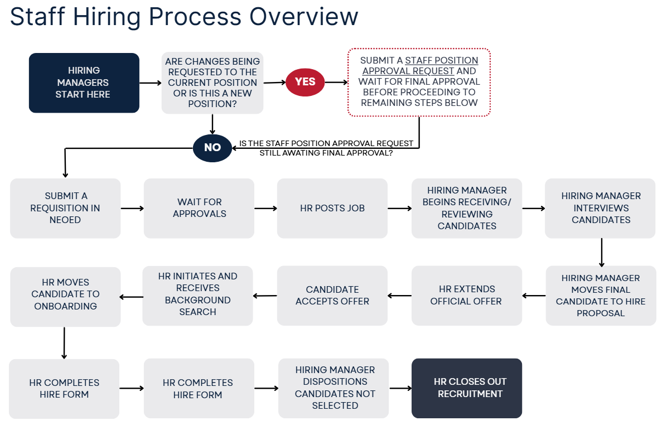
Job Posting
Once a requisition receives final approval in NEOED, the position will be posted. In accordance with University practice, all positions must be posted on the Samford University Employment Opportunities site for a minimum of three (3) business days. If the hiring department chooses to advertise the position on external job platforms, the applicants must be directed to apply through the official job posting link on the Samford Employment Opportunities site.
All official job offers, background checks, pre-employment requirements, and hiring actions will be completed and communicated by Human Resources through the applicant tracking system.
Application Process
In order to apply for a specific open position, interested persons should apply through the university job posting on the university’s applicant tracking system. Applications are not accepted outside of this process.
Résumés not submitted in response to a solicitation (posting) for a specific, open position or submitted outside of the university's applicant tracking software will not be considered or retained.
Applicants wishing to be considered for employment with Samford University must apply to a specific posting through the university’s applicant tracking system.
Recordkeeping
Keeping thorough and accurate records is a very important part of the employment process.
Records that hiring managers and team members must maintain in NEOED are:
- Accurately track each stage of the hiring process an applicant reaches to maintain a complete audit trail.
- Document the reason any applicant is not advanced in the hiring process.
- Record a disposition reason for every applicant who is not selected for the position.
- Send rejection email notifications to all non-selected applicants through NEOED.
- Maintain records of any testing or assessment results within NEOED.
- If using the candidate rating feature in NEOED, apply it consistently and base ratings on consistent measurable criteria throughout the candidate review process.
Screening
Once the job has been posted, the hiring manager will review all submitted application packages to determine the most qualified applicants who should be interviewed for the position. The screening may take place by:
- Comparing the minimum requirements of the job to the qualifications of those submitting applications/résumés.
- Telephone interviews of qualified applicants for determination of compatibility with Samford University’s mission, position salary, or other job-related factors.
- Applicants who do not meet the minimum posted qualifications may not be considered for the position.
Testing
Testing or assessments used to evaluate a candidate’s knowledge, skills, or abilities are administered by the hiring department. A hiring department may choose to include a test, task, work sample, or other assessment as part of the interview process. Any assessment should be developed and managed by the hiring department and must be administered consistently to all candidates being considered for the same position to ensure a fair and equitable evaluation process.
Departments may choose to conduct interviews before administering an assessment or administer the assessment before conducting interviews. Either approach is acceptable, provided the same process is applied consistently to all candidates for the position.
All documentation of any testing or assessments must be documented in NEOED.
Background Screening
Samford University conducts a background screening for all final candidates selected for employment. Successful completion of the background screening process is required before employment may begin. The screening may include, but is not limited to, criminal history, motor vehicle records, and Social Security number verification. Depending on the position and department requirements, additional screenings, such as credit history reviews or drug testing, may also be required.
Human Resources initiates the background screening process. Final candidates will receive instructions to complete an electronic background authorization through Choice Screening. Once this consent is submitted, the background screening will be processed automatically. Candidates may not begin employment or perform work duties until HR has received a clear and complete background report.
Final Candidate Selection
After interviews have been completed, the hiring manager should move the selected finalist to the Hire Proposal stage in NEOED. This action notifies the Employment Coordinator that the department has identified its preferred candidate and is ready for Human Resources to extend the official employment offer. If additional information or discussion is needed before the offer is made, the Employment Coordinator will contact the hiring manager.
Once Human Resources extends the official offer, the hiring manager will be notified and will continue to receive email updates throughout the remaining hiring and onboarding process.
Applicants who are not selected should be notified in a timely manner. The hiring manager is responsible for sending the appropriate non-selection communication through the NEOED system and ensuring all remaining candidates are properly dispositioned.
Final Step
As part of the onboarding process, all newly hired employees must complete the I-9 and E-Verify employment eligibility verification requirements. Federal law requires that the I-9 Form be completed no later than the employee’s first day of work, and E-Verify must be completed within the employee’s first three days of employment.
All newly hired employees are required to attend the next available New Employee Orientation session. Human Resources will send an email invitation with additional details to all new hires who are scheduled to attend an upcoming session. If you have any questions about onboarding requirements or orientation, please contact Human Resources at 205-726-2809 or employment@samford.edu.
Wage-Hour FAQs
What is the difference between exempt and non-exempt?
Exempt employees are exempt from overtime, paid by the job not by the hour. Non-exempt employees are not exempt from overtime; therefore, they are paid by the hour and are eligible for overtime.
How is a person determined exempt?
The duties of the job are compared to one of four tests prescribed by the Fair Labor Standards Act. The job duties must meet the standards set by one of these tests for the job to be considered exempt.
What records must be kept on non-exempt employees?
There are 12 items that payroll must keep in the pay records on non-exempt employees but the one item generated by the employee is the daily starting and stopping times.
An hourly (non-exempt) employee has agreed to work on a special project or event. How can I pay this employee?
Because hourly employees are subject to Department of Labor regulations, their exact hours must be documented for payment. These hours must be considered in combination with regular hours worked in computing overtime and the overtime rate of pay. You may not pay an hourly employee a “flat rate” for working on a project even though both parties may be agreeable to this arrangement; it is a violation of federal law. Please contact the payroll office for assistance in specific cases prior to engaging employees to work on special projects or events.
How precise should the starting and stopping time records be for non-exempt employees?
The wage hour regulations state that the records must reflect the employee's actual starting and stopping times, i.e., the times an employee begins work, starts and stops a lunch hour, and leaves for the day.
What records must be kept on exempt employees?
None that are generated by the employee. For the purpose of record keeping for Samford benefits, exempt employees must report the use of paid leave.
Must non-exempt employees be paid for training or meetings that are held after hours?
Yes, if the meeting or training is required for the employee, or if the employee's non-attendance at the meeting or training would have an impact on his/her job. Only if the meeting or training is 100% voluntary where the employee’s non-attendance would have no impact on his/her job would pay for the time not be required.
Are we required by the Fair Labor Standards Act to give employees breaks or meal breaks?
There are no provisions in the Fair Labor Standards Act (FLSA) for breaks of any kind nor are there any Alabama state laws that provide breaks. (Obviously we do want employees to be rested and refreshed for work so we do allow meal breaks, etc.) The FLSA covers only the payment of breaks so that breaks of less than 20 minutes are on the clock and breaks of 20 minutes or longer can be off the clock (non-compensable).
If a non-exempt employee eats at his/her work station during a meal break, is that compensable or non-compensable time?
We would have to pay the employee for that time. Breaks that are supposed to be off of the clock must be away from the work station so that the employee will not be interrupted or perform any work (such as answering the phone).
Who is paid overtime?
Non-exempt (hourly) employees who work in excess of 40 hours in a seven-day period (Sunday through Saturday) are paid time and one-half times their hourly rate for the hours worked in excess of 40.
An employee, of his/her own free will, comes in early, takes a short lunch hour, stays late, and as a result, incurs overtime. Does the overtime have to be paid?
Yes, if you allow an employee to work he/she must be paid. However, managers can and must control the workplace and the hours worked by employees.
What if the employee comes in because he/she wants to and does no work-just to avoid traffic, read the paper, drink coffee, etc. Is that compensable time that could lead to overtime?
No. It is not compensable time as long as the employee is not preparing the workplace for work or performing any work.
If an employee works over 40 hours in a seven-day period can he/she be given comp time and a half in lieu of time and a half dollars?
No, there is no such thing as comp time and a half (except in the public sector and we are not in the public sector).
When is the use of comp time legal?
Only when the comp time is used within the seven-day period in which it is earned. For example, an employee works eight hours a day Monday through Wednesday and 10 hours on Thursday. Comp time (hour for hour) of two hours could then be used on Friday to avoid time and a half pay. If the employee had worked eight hours Monday through Thursday and 10 hours on Friday, the comp time could not be used and overtime must be paid. The comp time cannot be carried over from one seven-day period to the next.
What about comp time for exempt (salaried) employees?
There is no such thing as comp time for exempt employees. Exempt employees are not paid by the hour and any accounting of their work by the hour could violate their exemption.
Do all hours count toward the computation of overtime?
Only actual hours worked count toward overtime. Any kind of paid leave does not.
Can requiring an employee to work overtime be made mandatory?
Yes.
Can employees volunteer to work off the clock?
No.
Management Forms and Resources
The forms below should assist those in management positions at Samford University with a variety of employment issues.
Faculty
- Faculty Employment Requisition
- Faculty Employment Form
- Change of Status Form
- Termination Form
- Employee Separation Packet
Staff
- Staff Additional or Temporary Job Assignment
- Staff Position Approval Request Form [NEW]
- Change of Status Form
- Termination Form
- Employee Separation Packet
Students
- Student Personnel Request Form
- Student Job Assignment Form
- Student Job Termination Form
- Student Employment Extension Form
- Student Pay Request Form
- SE Hiring Graphic

