In American sports, you cannot buy a player. You draft him, you trade for him, or you sign him as a free agent. Money moves between players and teams all the time, but one team does not simply write another team a giant check to take a player off their roster.
In the rest of the world, that giant check is the whole system. It is called a transfer, and it is how almost every player you will watch at this World Cup ended up at his club.
New here? This is Part 4 of a 10-part World Cup series. Start with Part 1: How Global Football Is Governed, Part 2: Club Football vs. International Football, and Part 3: Win or Go Down: Promotion and Relegation.
Players are bought and sold
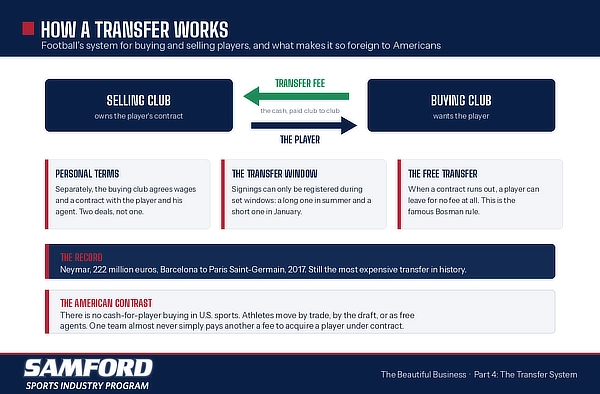
In football, players who are under contract are bought and sold between clubs for cash. If your club wants a player who belongs to another club, your club pays for him. That payment is the transfer fee, and it goes from the buying club to the selling club. No draft picks, no swapping players, just money.
It is really two deals at once
A transfer is two separate negotiations happening at the same time.
First, the two clubs have to agree on the fee. The buying club makes an offer, the selling club says yes or holds out for more, and they either land on a number or the deal falls apart.
Second, the buying club has to agree personal terms with the player, meaning his salary and the length of his contract. This is where the agent goes to work, pushing for the best wages he can get and taking a cut for himself.
Only when both of those are done, and the player passes a medical, does he sign and officially become a player for his new club. If either piece breaks down, the fee or the wages, the whole move can collapse.
The transfer window
Clubs cannot do this year-round. Players can only be signed and registered during set transfer windows, a long one in the summer and a shorter one in January. That deadline creates real drama. In the final hours before a window closes, fans sit glued to their phones waiting on last-minute deals, and the sports channels cover it live for hours. It is one of the most followed days on the entire football calendar, and all of it is about nothing more than players moving from one club to another.
The money is enormous
The fees are hard to wrap your head around. The world record still belongs to Neymar, who moved from Barcelona to Paris Saint-Germain in 2017 for 222 million euros. That number was so large that European football's governing body opened an investigation into how the club could even afford it. Fees of more than 100 million euros for one player are now normal. A club will pay another club more for a single human being than many professional teams pay their entire roster in a year.
The free transfer, and why it changes how you build a team
There is one big exception, and it opens up a whole strategy. When a player's contract runs out and he has not signed a new one, he is free to join any club he likes for no fee at all. This is known as the Bosman rule. It is why you sometimes see excellent players switch clubs for nothing. In 2024, Kylian Mbappe, the second most expensive player in history, joined Real Madrid for a fee of zero, simply because he ran his contract down first.
This is one of the things I find most fascinating as a fan. There is more than one way to build a team that can climb the pyramid or survive in the top division, and free transfers are one of the smartest. My own club, Leeds United, is a perfect example. Leeds is owned by 49ers Enterprises, the same group that owns the San Francisco 49ers, and last season, our first back in the Premier League, they leaned hard into a free transfer strategy, and it worked.
And this is the clever part. The players Leeds went after on frees were not random castoffs. They were players who had once been highly rated, even bought for big money by their former clubs, but whose careers had stalled for one reason or another, often injuries or a dip in form, to the point that their old club let them reach the end of their contract and walk away. The best example was our striker Dominic Calvert-Lewin, known to fans as DCL. He had real pedigree, but injuries had wrecked several of his seasons at Everton. Leeds bet that they could manage his body and get the best out of him, and getting him for free made that bet worth taking. It paid off. He became our main striker and scored the late winner in the final home game I flew over to watch. Leeds did the same with the German striker Lukas Nmecha, another talented player whose career had been stop-start, and brought him in on a free as well.
Our most recent one was a little different. This summer we signed Harry Wilson from Fulham, also on a free, but Wilson was no reclamation project. He had just come off a strong season. His contract was simply running down, and that points to a decision every selling club has to make. Once a player has only a year left on his deal, the club has to choose. Sell him now while you can still get a fee for him, or hold on to him and risk losing him for absolutely nothing when his contract expires. Leeds had actually looked at buying Wilson a year earlier, when it would have cost a significant transfer fee. Fulham chose to keep him, he had his good season, they tried to re-sign him, he decided not to stay, and in the end Leeds got him for free. That decision hangs over every contract in world football.
Loans, the other tool
There is one more way clubs move players around, and it is part of the same strategy. Clubs can loan players to one another. If a club has a young or fringe player who is not going to get much playing time, instead of letting him sit and rot on the bench, they send him to another club for a season to play real games. Often the loan comes with an option to buy at the end, usually a one-year loan with a purchase option built in.
This even changes which games you watch. Last season Leeds had several young players out on loan, and I found myself watching Championship games, England's second division, that I would otherwise have no reason to turn on, just to see how our loaned-out players were doing. And there is a real payoff in it. If one of those players has a great season, you have a good problem. Maybe he comes back and plays for you. Or maybe his value has jumped, and you sell him, sometimes to the very club that borrowed him, for far more than he was worth a year earlier, and put that money toward a player you actually need.
Following your club never stops
This is one of the things that makes following global football so different, and honestly so much fun. You are not just tracking your team from August to May. You are tracking it all year long. You follow every player on your roster, you learn how much time each one has left on his contract, you start to predict who might be sold and who might be bought, and you follow the reporters whose entire job is breaking transfer news. On top of that, you keep half an eye on the thousands of players at other clubs who might one day end up in your shirt. And there are a lot of them. FIFA counts nearly 130,000 professional male players at more than 4,000 clubs around the world, and every one of them is part of this same system of buying, selling, and loaning.
Keeping track of all that has become a real profession, and it is one of the areas where our students at Samford are building skills and landing jobs. I have a student right now who built a dashboard for a club that tracks thousands of players across leagues all over the world, monitoring everything from a player's current form, to how much time is left on his contract, to what his last transfer fee was. For a club like Leeds, which has far less money to spend than the giants such as Manchester United and Liverpool, getting these calls right is everything, and it is opening up real careers for the people who know how to read the market.
Why this matters for the World Cup
Now for the twist. Everything you just read is about club football, where money does the talking. The World Cup is the one place where none of it counts. You cannot buy a player for your national team. There is no fee that lets the United States sign a Brazilian, and no check big enough to put a French star in a Mexico shirt. At a World Cup, you get the players your country produced, and that is all you get.
But the World Cup still shapes the whole market, because it is the biggest shop window in the sport. As I write this, I am not only watching as an American, cheering on our men's national team, which I love. I am also watching four of my Leeds players represent four different countries. Ao Tanaka just played for Japan, who were knocked out by Brazil in heartbreaking fashion on a goal in the final minute. Gabriel Gudmundsson, our left back, has been playing left back for Sweden, so I have watched every Sweden game with one eye on him. Brenden Aaronson is here with the United States. And Noah Okafor is playing for Switzerland.
I want all four to do well for two reasons. First, they are Leeds players, and I am a fan. Second, there is no bigger stage on earth to drive up your value than a World Cup. A player from a smaller club, or from a lower league, who has a great tournament can earn himself a life-changing move, and earn his club a serious windfall when they sell him. For a club like Leeds, which has significantly less to spend than the biggest Premier League clubs, that matters enormously. We are always hunting for ways to stretch our money further and get the right players in the right roles so we can keep climbing the table. A strong World Cup from one of our own is one more way to do it. So when you watch this tournament, know that you are not just watching a competition. You are watching the prices change in real time.
Next up, Part 5: How Clubs Make Money. We have spent this whole article watching clubs spend. So where does all that money come from in the first place? We will follow it through television deals, match days, sponsorships, and player sales, and see why some clubs are rolling in it while others can barely keep the lights on.
Welcome to The Beautiful Business.
Part 1: How Global Football Is Governed
Part 2: Why Every Footballer Plays for Two Teams