


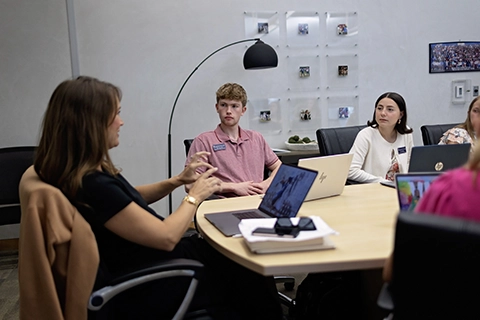
When national accrediting bodies and the U.S. Department of Education emphasized the importance of high-quality clinical partnerships in educator preparation, Orlean Beeson School of Education took this call to heart. The school reimagined its teacher preparation model, transforming coursework into immersive, hands-on learning through partnerships with two nearby schools: Trace Crossings Elementary School in Hoover, Alabama, and Homewood Middle School, just minutes from campus.
Designed to provide meaningful professional development for Samford’s early childhood, elementary, special education and collaborative education majors, these alliances bridge theory with practice.
“Classroom learning is only one piece of the puzzle,” said Anna McEwan, dean of Orlean Beeson School of Education. “Our students are set apart by the high-quality, practical experience these partnerships provide.”
From September through February, Samford students spend extensive time at Trace Crossings, designing small group activities, developing assignments and engaging in instruction alongside experienced mentor teachers. They attend professional meetings, assist with extracurricular activities and collect classroom data to analyze and discuss in their education courses.
Students also have on-site teaching labs, which are collaborative learning spaces where veteran teachers share expertise and model effective instruction. “The teaching labs are unique because they give teachers an opportunity to pass down their knowledge to those preparing to enter the profession,” said Erin Gilchrist, associate professor of secondary curriculum and instruction. “It’s a good opportunity for teachers to make a difference while our students gain hands-on insight.”
“We get to gather data from our students’ experiences and bring it back to class to debrief and develop strategies,” said Melissa Wallis, teacher education instructor. “Many of our class assignments are based in reality because our students can bring back real stories from their experiences.”
The success of the Trace Crossings model inspired a similar partnership for secondary education majors with Homewood Middle School.
“Homewood Middle School’s willingness to open their doors to our students is a key factor in our teacher education program’s success and national recognition from the Association of Teacher Educators,” said McEwan.
Students at Homewood Middle School participate in a Student Life Project, grounded in social connectedness theory—the idea that students are discovering who they are and where they belong beginning at the middle school age. The project challenges Samford students to engage beyond academics by volunteering in extracurricular activities and supporting school programs.
For Katelyn Hadder, a junior secondary education major, the experience has been transformative. “It’s been a great opportunity to not only get teaching experience, but to also get to know the people at the school,” she said. “Through the Student Life Project, I’m able to really connect with students in ways that go beyond the classroom.”
Reflecting on her time in the program, Hadder added, “Orlean Beeson School of Education provides so many opportunities to gain experience. I was already in classrooms as a sophomore. The amount of confidence and knowledge these partnerships bring is invaluable.
This story was first published in the fall 2025 issue of Samford magazine. You can read the issue online.
