


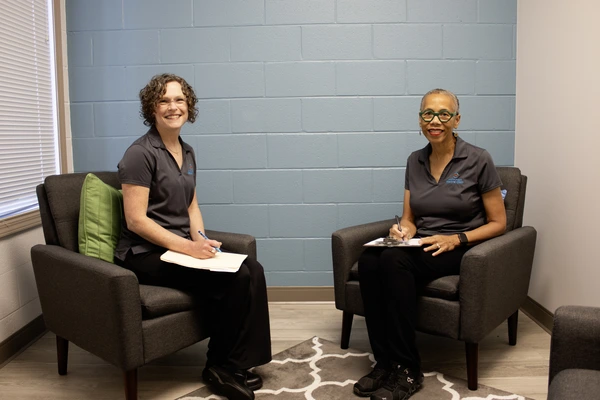
The courage to care is more than a phrase for those at Samford University’s Moffett & Sanders School of Nursing. It is a calling to show the light of Christ through acts of service.
Associate professors Sherri Chatman and Kristen Johnston have been living that calling through a volunteer and faith-based clinic they help lead at Hunter Street Baptist Church.
The vision for the clinic began years earlier when Johnston was serving on a mission trip with a retired internal medicine physician and fellow church member. During a conversation about using one’s gifts to honor the Lord, they realized students needed to see faith and professional calling lived out in real time. When Chatman later joined the effort, the idea grew into what would eventually become the Hunter Street Medical Clinic.
“We want our students to see that faith and nursing are not separate,” Johnston said. “Your faith, your profession and your service to the community are not three different lanes. They are one calling lived out in different places.”
The clinic primarily serves Hispanic families connected through English as a Second Language classes and community outreach. Care resembles what patients would receive in a traditional clinical setting. This includes prescriptions, screening tools for anxiety and depression and access to free or laboratory services. The clinic schedules about four appointments per clinic session while leaving room for last minute changes that often occur in underserved communities.
Many patients do not have insurance, which makes it difficult for them to see providers. Chatman and Johnston spent significant time within the community before the clinic opened. They attended Hispanic church services, spoke on mental health topics in Spanish speaking congregations and met families at school health fairs in both Jefferson and Shelby counties. They introduced themselves as neighbors and providers. Translators remain essential to ensuring every patient is understood and cared for.
“We really wanted to be part of the community, not just show up as providers,” Chatman said. “We wanted people to see us as neighbors first.”
One young man expressed his gratitude by saying, “Thank you for making space for me.” Moments like this remind them that even a single patient visit can be meaningful.
Hunter Street Baptist Church supports the clinic by providing space, equipment and seed funding. A nurse’s financial gift transformed a former Sunday school classroom into two fully functioning exam rooms. The clinic has become a shared effort shaped by mission and partnership.
“Every patient who walks through our doors is seen, loved and valued,” Chatman said. “We want them to know this is a safe place where they can be vulnerable, receive care and feel the presence of God through our service. Even if it is only one person at a time, that is enough. That is why we do this.”
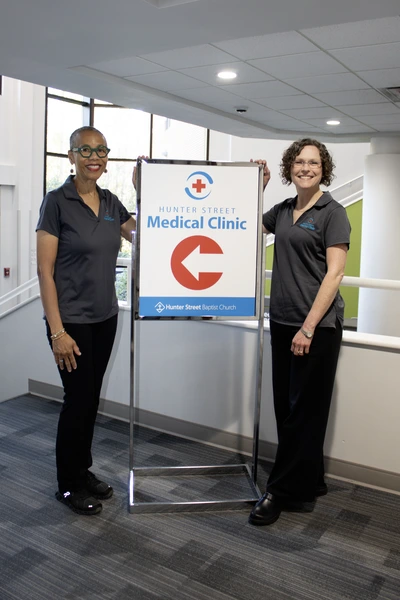
For Chatman and Johnston, the clinic strengthens their teaching. Both teach in the family nurse practitioner program, including pediatrics, family planning, community and women’s health courses.
They draw from their patient encounters to help students understand the importance of seeing the whole person rather than focusing only on symptoms or diagnoses. Their lessons encourage students to slow down, look away from the computer and notice the individual in front of them.
Brining real-world experience into the classroom directly supports Samford University #3 national ranking for career preparation from The Wall Street Journal/College Pulse 2026 Best Colleges in the U.S. list. What students learn in the classroom is not theoretical; it’s lived out through initiatives like the clinic.
“As we share about our clinic with students, they are reminded that nursing is about more than medications and charts,” Johnston said. “It is about seeing the whole person, caring with compassion and allowing your faith to guide how you serve.”
Their work has also led to significant scholarly activity. They have presented posters at the American Psychiatric Nurses Association conference and delivered podium presentations at the Alabama League for Nursing. Their next goal is to publish on the clinic’s model to encourage others who want to integrate faith, service and advanced practice nursing. Chatman and Johnston have been accepted for a podium presentation at an international nursing conference in March.
The clinic’s vision continues to grow beyond the local community. Through relationships with colleagues who have taught mental health content in Costa Rica and with a Samford faculty member who is currently serving in Honduras, Chatman and Johnston hope to one day offer international service opportunities for students. They believe caring for underserved populations, whether nearby or across the world, strengthens both clinical skill and character.
