


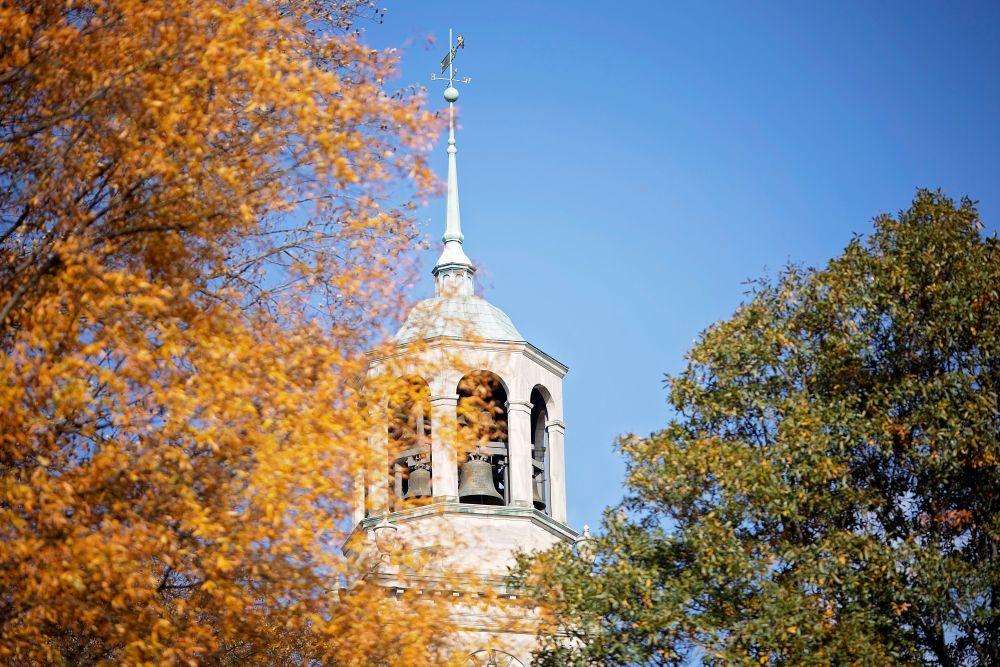
The wind sweeps through the bell tower above Samford University's campus. From his perch high above the quad, Jonathan Rodgers sees treetops stretching across campus, the sprawl of Homewood beyond and Shades Mountain rising in the distance.
Around him, dozens of bronze bells hang in close quarters, waiting to fill the air with sounds that have marked the rhythm of Samford life for nearly six decades. Now, Rodgers, associate professor of music and worship, has been entrusted with helping shape that soundtrack for a new generation.
Named Samford's university carillonneur, Rodgers becomes only the second person in the university's history to hold the title. He views the appointment as an honor and an opportunity to steward one of Samford's most recognizable traditions while exploring new ways for the bells to connect with students, alumni and the broader community.
"I'm excited to help continue a long tradition that Samford has had on its campus," Rodgers said. "It's something I believe in, am capable and qualified to do, and I'm eager to take on a new challenge, one that not only continues the heritage of our university but supports its campus and surrounding communities."
For Rodgers, the carillon's significance extends far beyond music. Throughout history, bells have served as instruments of communication, calling communities together to worship, celebrate significant occasions and mark important moments. That same sense of connection continues as the carillon's music reaches every corner of campus and beyond. Rodgers hopes current students will come to recognize the bells as a defining part of their Samford experience.
"Sounds and smells have a way of imprinting on our memory in ways that long outlast things we see," he said. "The daily rhythm of hearing the bells chime, marking the passage of time for each day and each generation of students, is a consistent, shared, audible experience."
He hopes those sounds become memories students carry with them long after graduation. When alumni hear church bells in another city or while traveling, Rodgers hopes those familiar tones will bring them back to their time on campus.
"I hope their minds and hearts will be filled with memories of a place where God did something great in their lives," he said.
That ability to create shared experiences is one reason Rodgers believes the carillon remains such a meaningful part of university life.
"Music, at its best, is a communal experience," Rodgers said. "The music from the carillon is going to be enjoyed by groups of people, whoever is within earshot of its bells. Even conversations around the table or on the quad about a song they heard can help build togetherness and a shared experience."
As the university carillonneur, Rodgers plans to preserve traditions that have made the instrument a beloved part of campus life while exploring new ways to engage the community.
"The responsibility is to steward it well, to use, care for and maintain it," Rodgers said. "In many ways, I'll serve as an advocate for this instrument, which is really a community instrument."
Rodgers compares the carillon to one of Samford's iconic oak trees, rooted in history yet still growing.
"It's always important to hold in tension the desire to look backward and look forward," he said. "The carillon is the perfect example of that. It's akin to one of our big oak trees on campus that continues to expand with new growth while being deeply rooted in its original soil."
Playing the instrument requires a remarkable blend of artistry and athleticism. Though similar to playing a piano or organ in some respects, carillon performance requires a distinct technique and far more physicality than many people realize. The musician must also account for the natural decay of each bell's sound, carefully choosing notes and textures that will resonate clearly across campus.
Rodgers plans to bring that intentionality to selecting music. His approach will balance familiar melodies people love with new pieces that invite listeners to hear the instrument in fresh ways.
As he begins this new chapter, Rodgers hopes the sounds drifting from the tower continue to mark rhythms of campus life while connecting generations of Samford students through a common experience.
And when students hear the bells ringing across campus in the years ahead, Rodgers hopes the feeling they associate with that sound can be summed up in a single word—“joy”.
The bells will ring again during Family Weekend, with Rodgers scheduled to perform at 3:30 p.m. Friday, Sept. 25.
