


A 10-part World Cup guide to the business of global football from Samford University's Sports Industry Program.
Imagine it is the final Sunday of the NFL regular season, and the three worst teams in the league are not playing for a high draft pick. They are playing to survive. Because in this version of the NFL, the bottom three teams do not get rewarded with the number one pick. They get kicked out of the league entirely, dropped down to a lower league, and replaced by the three best teams clawing their way up from below.
To an American sports fan, that sounds insane. To the rest of the planet, that is just how football works. It is called promotion and relegation, and once you understand it, you will never watch a "meaningless" late-season game the same way again.
The American way: a closed club
In the United States, our major leagues are closed shops. There are 32 NFL teams, and barring a rare expansion, there will always be those same 32. The same is true of the NBA, MLB, and the NHL. Your team cannot be removed for playing badly, and a brilliant minor-league team cannot earn its way in by winning. Membership is permanent, and you join by buying a franchise, not by being good.
We have even built our system to reward failure. Finish with the worst record and you are handed the No. 1 draft pick, the best young player available. It is a safety net designed to keep bad teams competitive, and it leads to the very American phenomenon of "tanking," where a team quietly tries to lose in order to draft higher. In most of the world, deliberately losing would be unthinkable, because losing has teeth.
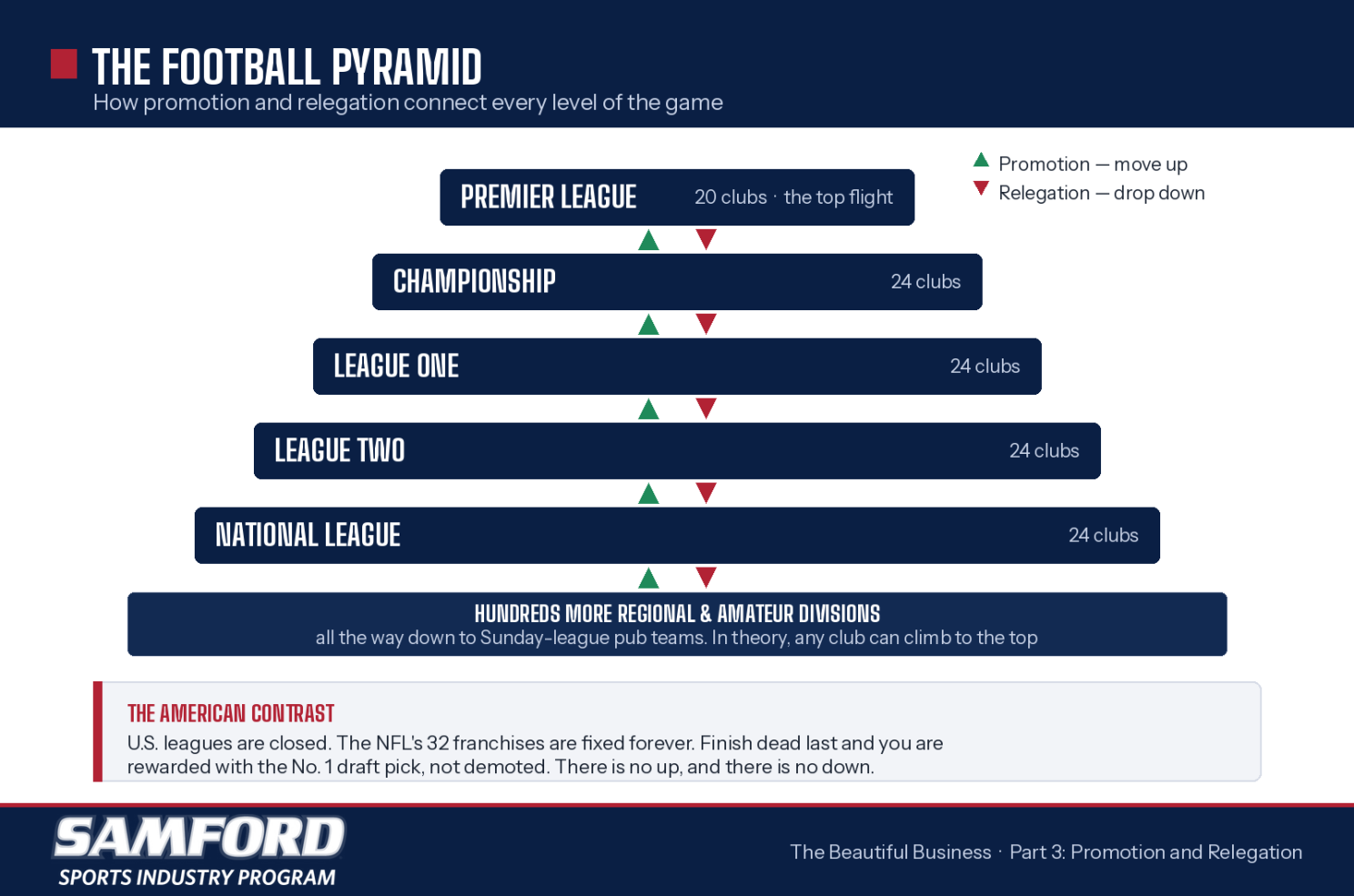
The rest of the world's way: The pyramid
Almost everywhere else, football is organized as a giant pyramid of leagues stacked on top of one another, all connected. In England, the Premier League sits at the very top. Directly beneath it is the Championship, then League One, then League Two, then the National League, and below that hundreds more regional and amateur divisions, all the way down to teams playing on public fields on Sunday mornings.
What connects all those levels is the simple, brutal mechanism of promotion and relegation.
How it works
At the end of every season, the teams that finish at the bottom of their division are relegated. They drop down to the league below. At the same time, the teams that finish at the top of that lower league are promoted up to take their place. In the Premier League, the bottom three teams go down, and three teams come up from the Championship to replace them.
So your league position is not a formality. It is everything. Where you finish decides which division you exist in next year, who you play, how much money you make, and in many cases, whether your club survives at all.
Why the stakes are enormous
This is where it stops being a quirk and becomes the beating heart of the sport.
Money is the first reason. The financial gap between divisions is staggering. A Premier League club can earn well over 100 million pounds a year in television money alone. Drop one level into the Championship, and that figure collapses. Relegation can mean layoffs, fire sales of your best players, and years of trying to climb back. Survival on the final day of the season is worth a fortune, which is why those games are played at a fever pitch that a draft-bound American team simply never experiences.
The second reason is the romance. Because the pyramid is open, a small club can dream. In theory, a tiny team from a lower division can string together promotion after promotion and rise all the way to the top. It does not happen often, but it happens enough to keep the dream alive and produce some of the greatest stories in sports.
I will admit my own bias here. My club is Leeds United, and I have lived this rollercoaster personally. Over the past two decades, we have not only been relegated from the Premier League, but have been relegated a second time, all the way down to League One, the third tier of English football. That is the part that really captures the desperation of this system. It is not simply that you can go down. You can go down, claw your way back up, and then go down again. So earning our way back to the Premier League for this past season meant more to me than most trophies do in American sports, precisely because we know exactly how far there is to fall.
And here is the part American sports fans find hardest to believe. As a Leeds fan, my goal for our first season back had nothing to do with winning the league. From the very first whistle, our entire hope was simply to finish above the bottom three and survive. That was it. After so many years grinding through the lower leagues, you understand that staying up in that first season is a massive achievement, both for the pride of it and for the financial security that remaining in the Premier League brings, which is a subject I will come back to later in this series.
It mattered so much that I bought tickets months in advance to be there with my youngest son for our final home game of the season, against Brighton. By then, we had already secured our survival with games to spare, so the day was a pure celebration. Dominic Calvert-Lewin won it 1-0 with a goal deep into stoppage time, and what happened afterward is something you would never see in American sports. We had finished 14th. We had won nothing. And yet the entire stadium stayed and sang Marching On Together, our anthem, over and over again. The players came back out and took a slow lap of the pitch, saluted one by one like conquering heroes, and the fans sang a song for each of them, with the loudest reserved for our manager, Daniel Farke.
If you did not know better, you would have sworn you were watching Arsenal celebrate their actual Premier League title. I saw the footage of their title party, and I am telling you, ours was every bit as intense and every bit as joyful. All for the achievement of avoiding relegation.
And here is the strange, wonderful truth. Next season will feel exactly the same. Recent history shows just how hard it is for a promoted club to stay up, with the previous six clubs to come up all going straight back down, and the first couple of seasons in the Premier League are the most precarious of all. So we will spend next year on a knife's edge too, sweating every single result, and I could not be happier about it. American fans may hear that and wonder why anyone would willingly sign up for that kind of stress. But there is something deeply fun about being part of building something real, where the downside is enormous and the progress comes little by little, season by season, carrying the genuine dream that one day this club could compete at the very top and play in Europe again. That is a ride worth being on.
That is the dynamic that changes everything about being a fan. When relegation is on the line, every single match matters for the entire season, because you know that if your team goes down, you may never again in your lifetime watch them play on the world's biggest stage. If I could wave a magic wand and bring one thing from world football over to American soccer, it would be exactly this. That mix of fear and hope, every single season, is something our closed leagues simply cannot manufacture.
Why this matters for the World Cup
Most of the players you will watch this summer were forged in this system. They grew up in clubs where every match carried weight, where a bad season had real consequences, and where there was always another rung above to climb toward. It builds a different kind of competitor.
It is also why our own Major League Soccer feels different to the rest of the world. MLS is built on the American model, a closed league with no promotion or relegation, and whether the United States should ever adopt the global system is one of the most heated debates in American soccer. Now you understand exactly what that debate is about.
Part 1: How Global Football Is Governed
Part 2: Why Every Footballer Plays for Two Teams
