


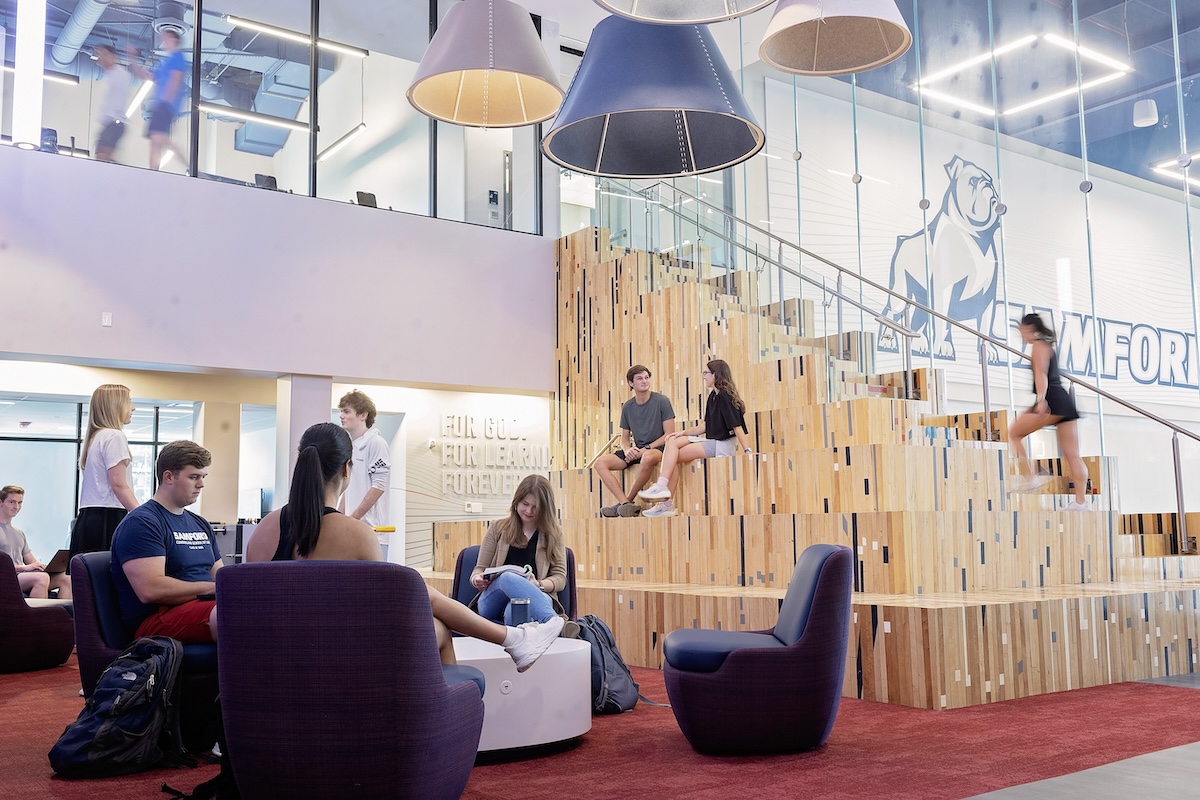
Samford University’s national award-winning Campus Recreation, Wellness & Athletics Complex—an $85 million expansion of Seibert Hall completed in September 2024— earned Leadership in Energy and Environmental Design (LEED) certification in May.
Days later, on June 3, the university’s newest student housing complex, Audrey Lattimore Gaston Hall and Marvin L. Mann Hall, also earned LEED certification.
Thoughtfully reimagined and constructed, Seibert Hall became the first Samford building to seek LEED certification for health, sustainability, energy efficiency and cost savings.
“A building is the physical manifestation of the values the community holds. A LEED certification is independent validation of Samford’s commitment to student and employee well-being,” said Colin Coyne, Samford’s vice president of finance and business affairs.
The campus recreation project transformed Seibert Hall into a four-story, 165,000-square-foot facility that combines world-class fitness amenities with communal spaces for students and employees.
“LEED certification mandates a rigorous set of independently quantified and, very importantly, independently verified standards,” said Coyne, who has more than two decades of experience as a LEED accredited professional. “To meet these standards requires broad vision, consistent and integrated intent, and ultimately exacting care in execution. It’s not just about thoughtfulness in the sense of doing what’s right to ensure physical well-being, it requires thoughtfulness in every aspect of our approach.”
Seibert Hall’s primary sustainability features included conserving resources by reimagining an existing building rather than demolishing it. That included salvaging and reusing original building materials such as the historic basketball court’s wood flooring for student gathering platforms and wayfinding throughout the building.
Key design features include:
- new systems to reduced water use inside and outside the building
- upgraded mechanical units with energy-efficient systems
- air-monitoring devices to assure high indoor quality
- low-emitting materials to enhance the patron experience
- daylit spaces throughout the building.
“Designing sustainably isn't new to our work with Samford,” said Neil Davis, president of Davis Architects, the university’s primary architecture partner since the 1950s. “It's how we've approached the campus for years, applying the same principles behind the university's own sustainability goals to conserve energy, limit environmental impact, and protect water resources—even on buildings that never pursued formal certification.
“With the Seibert Hall renovation and expansion, those long-standing practices were independently measured and verified through LEED. It’s a building that is both beautiful and recognized for its environmental performance—and a milestone in a partnership we've valued for generations.”
Developed by the U.S. Green Building Council, LEED is the global standard for sustainability achievement and leadership.
