


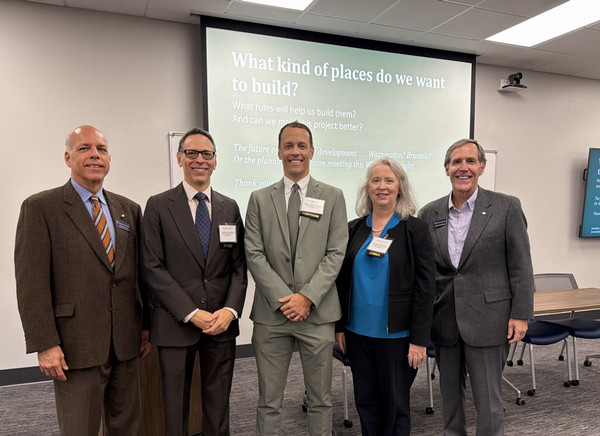
Samford University's Cumberland School of Law brought together attorneys, developers, business leaders, academics and students on Oct. 19 for “Opportunities and Challenges in Real Estate and Sustainable Development,” a half-day symposium examining the legal, economic and environmental forces shaping growth throughout Alabama and beyond.
Hosted by Cumberland School of Law's Land Use and Natural Resources (LUNR) Law Center and Continuing Legal Education department in partnership with Brock School of Business' Real Estate program, the event brought together experts from law, conservation, development and industry to discuss how economic growth and sustainability can work hand in hand.
"The challenges facing growing communities are increasingly complex and interconnected," said Blake Hudson, dean of Cumberland School of Law and director of the LUNR Center. "Addressing issues related to development, land use and positive environmental outcomes requires collaboration across professions and disciplines. This symposium created an opportunity for meaningful conversations about those challenges and the solutions that can help communities thrive."
The program featured three sessions focused on key issues at the intersection of real estate, land use and sustainability.
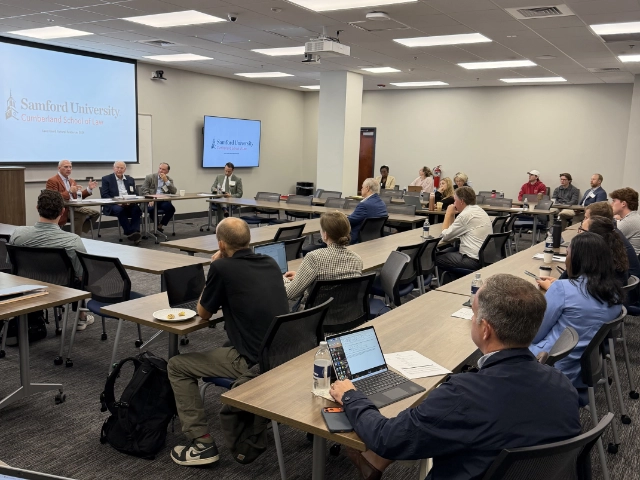
A second panel featured attorneys from Bradley, including William "Buddy" Cox and alumni Beau Byrd, JD ’92, and Steve Monk, JD '80, who discussed environment law complexities affecting real estate projects. The conversation highlighted evolving regulatory and business challenges facing developers, landowners and local governments across the region.
The symposium concluded with a keynote presentation by Jonathan Rosenbloom, distinguished professor of law at Albany Law School. A nationally recognized land use and property law scholar, Rosenbloom shared insights on how legal and policy frameworks can help address emerging environmental concerns while supporting responsible development.
Author of numerous books and publications on land use, climate policy and food systems, Rosenbloom encouraged attendees to think critically about the role lawyers, policymakers and business leaders play in shaping the future of cities and regions.
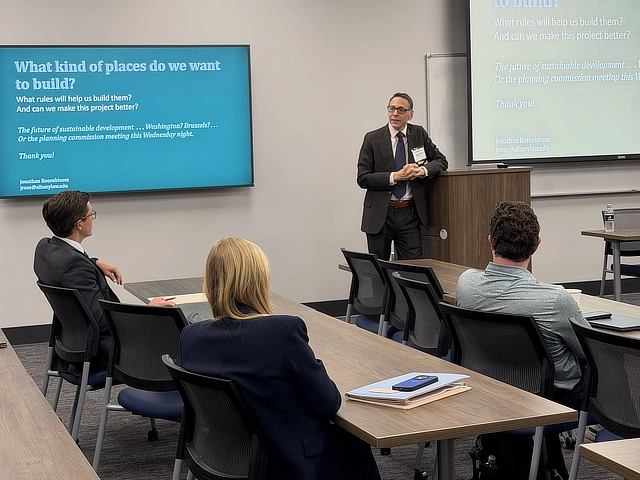 “The decisions we make about real estate and land use shape far more than individual projects,” Rosenbloom said. “They help determine the communities we build, the opportunities people have, and the environment we leave for future generations. Bringing together lawyers, business leaders, academics, and students is essential because the challenges we face do not fit neatly within any one discipline. Just as importantly, these conversations help prepare the next generation of leaders to ask not only how we get a project done, but how we can make it better. That is where meaningful progress begins.”
The event reflects Cumberland School of Law's ongoing commitment to convening conversations around issues at the intersection of law, business and public policy, while equipping professionals to navigate the opportunities and challenges of a changing landscape.
