


History
A leader in legal education since 1847.
Founded in 1847 by Judge Abraham Caruthers, Cumberland School of Law has prepared generations of lawyers through a steadfast commitment to practical legal education. From its origins in Tennessee to its home at Samford University in Birmingham, Cumberland has built a tradition of collegiality, service, and professional excellence that continues today.

1847: Antebellum Beginnings
Cumberland School of Law opened in Lebanon, Tennessee, on Oct. 1, 1847, with seven students under the leadership of founding professor Abraham Caruthers. At a time when university-affiliated law schools were rare, enrollment quickly grew, and the school earned a reputation for rigorous legal training.
From its earliest days, Cumberland emphasized practical preparation for the profession through moot court, classroom recitations, and examinations. This focus on developing skilled, practice-ready lawyers became a defining characteristic of the Cumberland experience and remains central to the school's mission today.

1865: Rebuilding After the Civil War
The Civil War left the Cumberland University campus in ruins, with many buildings destroyed during the conflict. Yet the law school endured, rebuilding its program and reaffirming its commitment to legal education.
The school's recovery inspired the adoption of the phoenix as a symbol of renewal and perseverance. In 1866, trustees adopted a new seal featuring the phrase E Cineribus Resurgo ("I will rise from the ashes"), a reflection of Cumberland's resilience and determination to move forward.
Support from alumni and community leaders helped strengthen the law school in the decades that followed, including the construction of Caruthers Hall in 1878, which provided a dedicated home for legal education.

1930s: Rascal Day
One of Cumberland School of Law's most beloved traditions traces back to Rascal, a white-haired dog who became the law school's unofficial mascot during the 1930s. Known for attending classes and sitting alongside professors, Rascal became a familiar presence in the daily life of the law school.
In 1935, students awarded Rascal an honorary degree in canine jurisprudence. After his death in 1940, he was buried on campus and later reinterred at Samford University when the law school moved to Birmingham in 1961. Today, Cumberland continues to honor Rascal's memory through its annual Rascal Day tradition.
1940s-1960s: Growth and Transformation
Following World War II, Cumberland School of Law adopted a three-year curriculum and the case-method approach that had become the national standard in legal education. Under Dean Arthur Weeks' leadership, the law school expanded its faculty, strengthened its library, and enhanced its facilities.
These efforts resulted in full approval by the American Bar Association and membership in the Association of American Law Schools in 1952. Despite these achievements, declining enrollment and financial challenges threatened the school's future and prompted leaders to explore opportunities for a new institutional partnership.


1961: A New Chapter in Birmingham
In 1961, Cumberland School of Law became part of Howard College, now Samford University, and relocated from Lebanon, Tennessee, to Birmingham, Alabama. The move preserved the law school's accreditation, traditions, and longstanding reputation for legal education while positioning it for future growth.
The transition marked a pivotal moment in Cumberland's history, bringing together the law school's rich heritage and the resources of a growing university. In 1965, Howard College became Samford University, establishing the foundation for Cumberland School of Law's modern era.
1967: Cumberland Begins to Integrate
In 1967, Audrey Lattimore Gaston Howard became the first African American student to enroll full time at Samford University through Cumberland School of Law. Her enrollment marked a significant milestone in the history of both the law school and the university.
Howard graduated in 1970, becoming the first African American graduate of Cumberland School of Law. She went on to break additional barriers in the legal profession, including becoming the first woman appointed to the U.S. Attorney's Office in the Southeast. Her legacy continues to inspire generations of Cumberland students and graduates.


1970s: Student Leadership and Advocacy Excellence
During the 1970s, Cumberland School of Law expanded opportunities for student leadership, advocacy, and professional development. Student organizations, moot court teams, and the Student Bar Association earned regional and national recognition, helping strengthen the school's growing reputation for advocacy excellence.
In 1974, Cumberland established the Cordell Hull Speakers Forum, which has brought distinguished leaders from law, government, business, and public service to campus. During this era, the school's advocacy programs also gained momentum, laying the foundation for the nationally recognized trial advocacy tradition that continues today.
1990s: Expanding for the Future
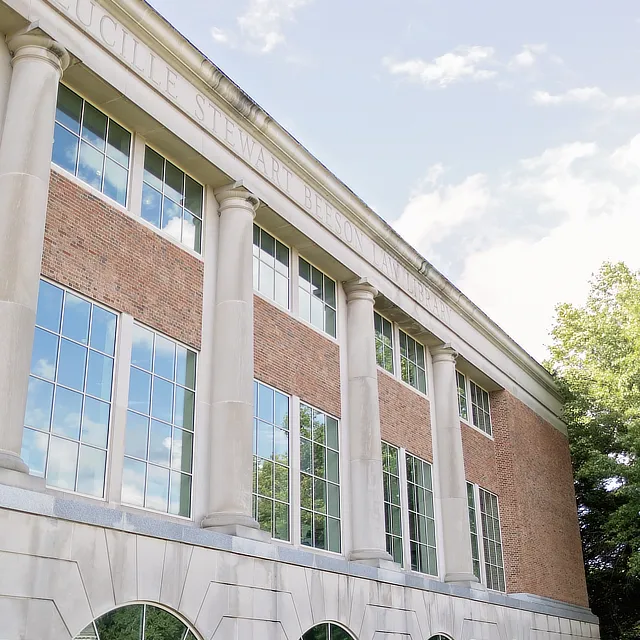
As Cumberland School of Law continued to grow, plans were developed for a dedicated law library to support future generations of students and scholars. Thanks to a generous gift from longtime Samford benefactor Lucille Stewart Beeson, construction began on a new library adjacent to Robinson Hall.
The library opened in 1995, providing expanded space for study, research, and collaboration. Dedicated in 1996 by former President Gerald R. Ford, the facility remains a central part of the Cumberland experience and a lasting symbol of the school's commitment to legal education.

Cumberland Today
Today, Cumberland School of Law builds on nearly 180 years of preparing lawyer-leaders through rigorous academics, nationally recognized advocacy training, experiential learning opportunities, and a supportive community. As part of Samford University, Cumberland remains committed to developing skilled attorneys who serve their clients, professions, and communities with excellence and integrity.
Cumberland's longstanding commitment to practical legal education continues through nationally recognized advocacy programs, with students regularly competing and earning distinction in regional and national trial and moot court competitions. The school's advocacy tradition remains a defining part of the Cumberland experience.
In recent years, Cumberland has expanded opportunities for experiential learning through legal clinics that allow students to represent and assist real clients under attorney supervision. These programs provide hands-on experience while serving the community.
The law school has also broadened its reach through innovative graduate programs designed for professionals seeking legal knowledge outside the traditional Juris Doctor curriculum. These programs extend Cumberland's educational mission to a wider audience while addressing the evolving needs of today's workplace.
