


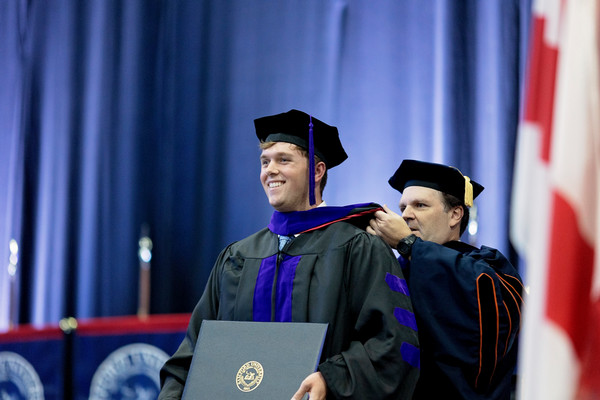
When Levi Wolff, JD '26, arrived at Samford University's Cumberland School of Law, he knew he wanted to practice tax law. What he didn't anticipate was how quickly that interest would turn into a front-row education in the federal judiciary—taking him all the way to Washington, D.C., before his final law school semester began.
Wolff completed his law school coursework early so he could spend the spring of his third year clerking for the Honorable Cathy Fung on the U.S. Tax Court. It offered the rare chance to observe judicial decision-making firsthand and contribute meaningfully at one of the nation’s most specialized federal courts.
“From an academic standpoint, I wanted to free up as much time as possible for work opportunities,” he said. “I wanted more chances to get practical experience before I started studying for the bar.”
That mindset paid off, but not without unexpected twists.
Originally, Wolff planned to spend the summer before his third year working with the Internal Revenue Service. When that externship was canceled just weeks before his start date due to a federal hiring freeze, he pivoted. In a last-minute effort to stay engaged in tax law, he reached out directly to the U.S. Tax Court to inquire about opportunities.
That outreach led to a connection with Fung, who had recently been appointed to the court and was in the process of establishing her chambers in Washington, D.C. While the timing didn’t align for a summer position, Fung invited Wolff to interview for a spring externship instead.
“At first, I wasn’t sure I could make it work with my class schedule,” Wolff said. “But once I sat down and did the math—and talked with the law school administration—I realized that if I took summer classes and carried a full fall semester, I could earn my remaining credits through the clerkship and still graduate on time. Quite frankly, it was too good of an opportunity to pass up.”
The U.S. Tax Court occupies a unique position within the federal judiciary, and Wolff discovered that its work extends far beyond numbers on a page. While the court hears disputes over substantive tax law, it also serves as a critical check on the Internal Revenue Service’s administrative authority.
Wolff worked on cases involving Collection Due Process and Innocent Spouse claims—both highly fact-specific matters with significant consequences for taxpayers. “You really see how the law affects people’s day-to-day lives,” he said, noting that many cases centered on procedure as much as substance.
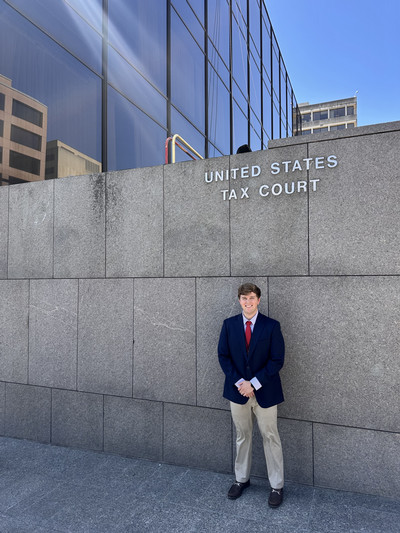 A typical day began with a walk to chambers that took him past the U.S. Supreme Court and Capitol buildings. Once there, Wolff immersed himself in legal research, drafting and analysis. His primary responsibility as an extern was to draft a full judicial opinion from start to finish over the course of the semester—an experience far more substantive than he initially expected.
“I assumed I would mostly be helping the full-time clerks,” Wolff said. “Having the responsibility to complete my own opinion was a huge opportunity.”
That responsibility was supported by the foundation he built at Cumberland. Wolff credits Professors Tracey Roberts and Alyssa DiRusso with preparing him for the technical demands of tax practice through courses in federal income tax, corporate and partnership tax, estate and gift tax, and state and local tax.
“Without that foundation, there’s no way I could have worked in D.C.,” Wolff said.
He also pointed to his first-year coursework in civil procedure and legislation, taught by Professor Jeff Anderson, as critical preparation. “Tax Court procedure is different from federal civil procedure, but the framework I learned as a 1L translated directly.”
Working closely with Judge Fung also reshaped Wolff’s perspective on the judiciary. Observing how she managed multiple cases simultaneously—often recalling facts and procedural histories without hesitation—left a lasting impression.
“It was humbling,” he said. “Seeing the level of preparation and mental discipline it takes to run chambers really made me appreciate how hard judges work to keep the system moving.”
As a new Cumberland School of Law graduate, Wolff’s experience has affirmed his commitment to tax law and influenced next steps. After taking the Alabama bar exam, he will pursue a Master of Laws (LLM) in taxation at New York University School of Law.
Reflecting on his time at Cumberland, Wolff is most proud of his willingness to say yes to new experiences, unexpected opportunities and paths he couldn’t have predicted when he started law school.
“Whether it was studying abroad, serving as a student ambassador, or clerking for a Tax Court judge in Washington, D.C., there were opportunities everywhere,” he said. “You just have to go out and look for them.”
For students considering judicial clerkships or competitive externships, Wolff’s advice is simple: “If you have the opportunity to clerk for a judge, you should absolutely take it. Real-world experience teaches you things you can’t learn in the classroom. When opportunity knocks, you have to answer.”
