


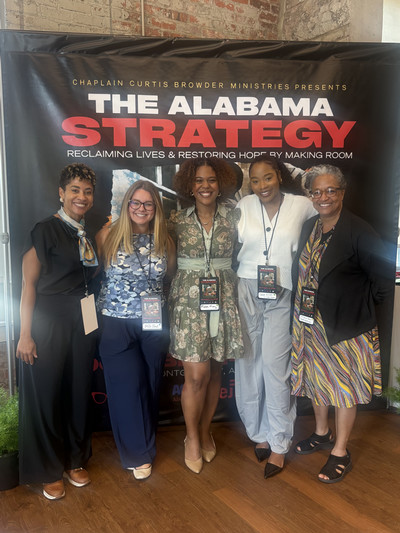
Faculty and students from Samford University Cumberland School of Law recently joined advocates, legal professionals, policymakers and community leaders from across Alabama for the Alabama Strategy Summit, Reclaiming Lives & Restoring Hope by Making Room, held Oct. 1-3 in Montgomery, Alabama. The summit’s focus on collaboration and community engagement resonates with the vision guiding Cumberland’s Center for Civil Rights & the Law and its broader commitment to civil rights and the pursuit of justice.
LaJuana Davis, the Leslie S. Wright Chair of Law and director of Cumberland’s Innocence Clinic, and Chinelo Diké-Minor, associate professor and faculty adviser for the Black Law Students Association, attended the summit alongside students Haley Wilson, Bella Clark and Mariah Moore. Hosted by Faith Crusades Ministries, led by Chaplain Curtis Browder, the gathering brought together individuals and organizations working to address reoffending, support successful reentry after incarceration and improve outcomes for people impacted by the criminal justice system.
Faith Crusades Ministries has provided housing, food and supportive services to formerly incarcerated individuals for nearly 45 years. The Alabama Strategy Summit creates opportunities for organizations and practitioners working across criminal justice, healthcare, housing and community development to share ideas, learn from one another and strengthen collaborative efforts toward lasting change.
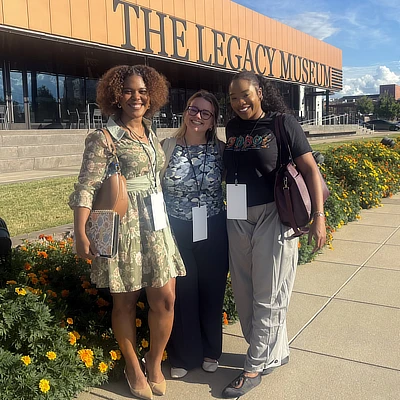 The summit opened with a keynote address from Equal Justice Initiative founder Bryan Stevenson and featured presentations from former Alabama Supreme Court Chief Justice Sue Bell Cobb, representatives from the Alabama Appleseed Center for Law & Justice and others engaged in justice reform efforts throughout the state.
Conference sessions explored a range of issues, including parole reform, reentry support, the human impact of solitary confinement and pretrial detention, and the legacy of Miller v. Alabama, the landmark U.S. Supreme Court decision addressing mandatory life-without-parole sentences for juvenile offenders.
Several discussions connected directly to experiential learning opportunities available to Cumberland students. Through the law school's Parole Clinic, students partner with Redemption Earned, a nonprofit organization co-founded by Cobb that advocates for parole reform and supports individuals impacted by incarceration. Participants also heard from leaders of Alabama Appleseed, where several Cumberland students have completed internships focused on justice-related policy issues.
For Diké-Minor, the summit demonstrated the value of connecting students with practitioners and advocates whose work reflects the issues they study in the classroom.
“Our students spent three days learning from people who do this work every day: advocates, attorneys, physicians, and community leaders working on incarceration and its effects—from sentencing and detention to public health and civic participation,” Diké-Minor said. “They learned firsthand how legal advocacy can transform the lives of individuals and strengthen systems and communities across our state. Creating opportunities like this is exactly why the Center for Civil Rights & the Law exists.”
For the students in attendance, the summit offered an opportunity to connect legal education with real-world efforts to advance justice and serve communities across Alabama.
"Attending the Summit was a meaningful opportunity to step outside the classroom and engage with conversations about justice, advocacy and the future of Alabama," Wilson said. "I have followed Bryan Stevenson's work since I was a sophomore in college, so finally having the opportunity to hear him speak in person was an honor."
Wilson said the experience helped her better understand the role attorneys can play in creating positive change.
"More than that, hearing the stories and testimonies of those doing this work allowed me to see what it looks like in practice to contribute to this cause and to serve as an attorney and advocate for justice," she said. "I left feeling encouraged and challenged to think more intentionally about the kind of lawyer I want to become."
Moore echoed those sentiments, describing the summit as both inspiring and eye-opening.
"My experience at the Alabama Strategy Summit was illuminating," Moore said. "The perseverance and courage I witnessed reminded me why I'm in law school and opened my eyes to different perspectives on what humanity in the justice system looks like."
One message from Stevenson's keynote remained with her long after the summit concluded.
Stevenson told attendees that "each of us is more than the worst thing we've ever done," a sentiment that resonated deeply with Moore.
"Hearing people describe overcoming mistakes, challenging false accusations and fighting through difficult circumstances reaffirmed my desire to advocate for those who have been wronged and empower them as they seek justice and restoration," she said.
The experience reflected the mission of Cumberland School of Law's Center for Civil Rights & the Law, which seeks to prepare students to engage thoughtfully with issues of justice, equality and civil rights through legal education, advocacy and service. Through opportunities such as the Alabama Strategy Summit, Cumberland students are able to connect classroom learning with real-world conversations about justice, restoration and the ongoing work of strengthening communities throughout Alabama.
