


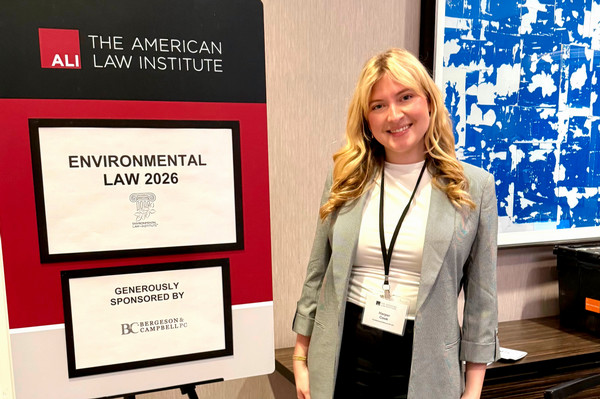
Harper Cook, a second-year student at Samford University’s Cumberland School of Law, recently represented the school at the American Law Institute’s Environmental Law Conference, one of the nation’s leading gatherings for environmental law scholars, practitioners and policymakers.
The conference, held in Washington, D.C., gave Cook an opportunity to deepen her understanding of a rapidly evolving field and connect classroom lessons with real-world practice. Her motivation for attending was rooted in curiosity and career preparation.
“I wanted to strengthen my understanding of environmental law and stay current on recent developments in the field,” she said. “Because I’m currently taking Environmental Law, attending the conference gave me the chance to hear about many of the same topics in a real-world context while learning them in the classroom.”
As one of the inaugural student fellows in Cumberland’s Land Use & Natural Resources (LUNR) Law Center, Cook found that the conference aligned closely with the center’s mission and her own interests. Hearing directly from experienced practitioners provided a meaningful extension of the work she engages in with the center.
“The conference allowed me to learn more about the most pressing and emerging issues in environmental law,” Cook said. “This knowledge is directly relevant to the work we do in the LUNR center.”
Over the course of several days, sessions delved into the legal and regulatory issues shaping environmental law today. Cook said the panels expanded on concepts she has studied in both Environmental Law and Natural Resources Law. Discussions covered major statutes and topics including the National Environmental Policy Act (NEPA), the Endangered Species Act (ESA), the Toxic Substances Control Act (TSCA), climate policy, renewable energy development and recent U.S. Supreme Court decisions affecting environmental regulation.
“It was especially valuable to hear how these laws are currently being interpreted and applied, as well as how shifting administrative priorities may influence their future,” she said.
Cook credited her recent summer externship experience—primarily focused on water law—with providing a foundation that helped her engage deeply with the conference content.
“The conference allowed me to see how water law fits within the larger environmental legal system,” she said. “It exposed me to additional areas such as climate policy, natural resource management and federal regulatory processes.”
As she prepares for a career in environmental and natural resources law, Cook believes the combination of her fellowship experience and professional development opportunities like attending the conference have already played a significant role in shaping her path.
“Together, these experiences have strengthened my legal knowledge, expanded my research interests, and better prepared me to pursue a career in environmental and natural resources law,” Cook said.
Launched in 2025, Cumberland’s Land Use & Natural Resources Law Center provides students and faculty an opportunity to address critical environmental issues. The center, launched with initial support from Samford University’s Innovation Fund as well as support from individual donors, offers a range of hands-on opportunities for students, including discipline-specific externships and the new study abroad summer program in Iceland exploring topics like sustainability and geothermal energy.
“To date, we’ve secured more than $1 million in support of the center—an investment that directly fuels transformative experiences like Harper’s,” said Cumberland School of Law Dean Blake Hudson, director of the center. “These funds will expand access to opportunities that empower our students to thrive.”
