


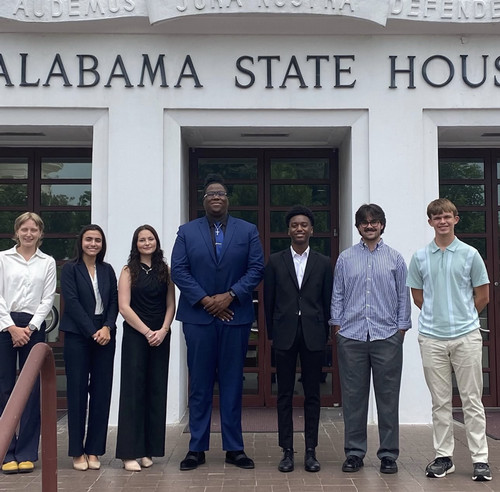
Samford University student Westin Baker spent his summer gaining firsthand experience with Alabama’s legal system through an internship with the Alabama Appleseed Center for Law and Justice. The experience allowed the senior sociology major to apply what he has learned in the classroom while seeing how laws, institutions and social systems affect people across the state.
Baker served as a storyteller intern with Alabama Appleseed, a nonprofit organization focused on criminal justice reform and policy advocacy.
Baker interviewed clients and gathered their stories to strengthen the organization’s policy reform efforts. He produced two comprehensive reports detailing clients’ experiences and presenting proposals for policy change.
He also researched Alabama Department of Corrections policies, particularly those involving family contact, communication limitations and compassionate release.
The work gave Baker an opportunity to examine public policy from multiple perspectives—from the language contained in official documents to the experiences of people directly affected by those policies.
That connection became especially clear when Baker attended a meeting of the Joint Legislative Prison Oversight Committee in Montgomery, Alabama.
Before the meeting, Baker had spent much of his summer researching correctional policies through documents, firsthand accounts and conversations with Alabama Appleseed staff. At the committee meeting, formerly incarcerated individuals and family members of people who were incarcerated discussed how policies and practices within Alabama’s correctional system affected them.
For Baker, hearing those experiences brought much of his summer research into sharper focus.
“I got to see the gap between policy on paper and policy as it’s actually experienced in real time,” Baker said.
The meeting was difficult at times as participants described the realities they and their families experienced. But Baker said being present reinforced the importance of improving the system.
His sociology education at Samford’s Howard College of Arts and Sciences prepared him to process those experiences and approach his internship with a broader perspective.
“My sociology studies at Samford prepared me for my internship by presenting a multitude of theories and concepts about the dynamics of power and people in our society,” Baker said.
Concepts including cumulative disadvantage, life course theory and the sociological imagination provided what Baker described as a “structural lens” for his work. Rather than looking only at individual circumstances, he could consider how larger systems and institutions influence people’s experiences.
That perspective became especially important when interviewing clients.
Baker said his sociology background helped him recognize systemic consequences rather than attributing an individual’s circumstances solely to personal actions. Working directly with clients taught him something the classroom alone could not.
“Sociology does a great job of providing me with frameworks and theories, but my internship allowed me to see some of these ideas in real time,” Baker said.
Ideas that could seem abstract in a classroom became more tangible when connected to the experiences of real people. Baker also discovered that theories do not always fit neatly when applied to individual circumstances.
That lesson deepened his understanding not only of sociology but also of the kind of work he hopes to pursue after Samford.
Before the internship, Baker was already considering law school or a master’s degree in public administration. His experience with Alabama Appleseed strengthened his interest in criminal justice reform while showing him the importance of combining policy work with relationships and direct advocacy.
“I did not realize how much good reform comes down to relationships and hands-on advocacy,” Baker said.
His experience at the legislative oversight meeting further developed his interest in the intersection between public policy and the people it affects.
Rather than envisioning a career spent exclusively working behind a desk, Baker is increasingly drawn to criminal justice reform law and other work that would allow him to engage directly with people while remaining attentive to broader social structures.
Through that combination, Baker sees an opportunity to continue putting the perspective he has developed as a sociology student into practice—connecting an understanding of systems and institutions with their human impact.
GIVE NOW: Support impactful work at Howard College of Arts and Sciences.
