


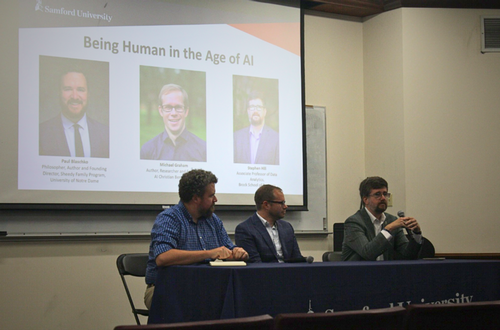
As artificial intelligence continues to transform education, the workplace and everyday life, Samford University brought students, faculty and experts together Oct. 29 for AI Day, a new event that explored the opportunities, challenges and ethical questions surrounding one of today's most influential technologies.
Hosted by Howard College of Arts and Sciences in collaboration with Brock School of Business and the Samford University Library, the event featured a hands-on technology workshop, expert panel discussion, classroom visits and an evening lecture. Sponsored by Professional Advancement Through Howard (PATH), AI Day encouraged participants to consider how artificial intelligence is changing the world and how individuals can use it responsibly.
A central highlight was the panel discussion, "Being Human in the Age of AI." The conversation featured Stephen Hill, associate professor of data analytics in Brock School of Business; Michael Graham, author, researcher and director of the Gospel Coalition's Keller Center for Cultural Apologetics; and Paul Blaschko, philosopher, author and founding director of the Sheedy Family Program at the University of Notre Dame. Dean Brad Lail of Brock School of Business moderated the first half of the discussion, while Dean Dawn McCormack of Howard College of Arts and Sciences led the second half.
The discussion began by examining how students can use AI tools such as ChatGPT to enhance learning without replacing the critical thinking and intellectual development essential to higher education.
Hill emphasized that artificial intelligence has transformed his approach to teaching, allowing students to explore advanced concepts and receive personalized learning support. However, he cautioned that AI also makes it easier to bypass foundational knowledge.
"AI has enabled my students to be able to approach topics in really unique ways, in ways that we hadn't been able to do in the past," Hill said.
Graham expanded on that idea, arguing that the growing accessibility of information is changing the fundamental purpose of higher education. Rather than simply acquiring knowledge, students must develop the ability to learn independently and adapt throughout their lives.
"One of the most important things that you can acquire as a student is the ability to learn how to teach yourself," Graham said.
Blaschko highlighted AI's potential to improve education through individualized instruction and immediate feedback. He suggested that these tools could help students master foundational material more efficiently, allowing educators to devote additional classroom time to meaningful discussions and deeper engagement.
"I think the goal is to increase the kinds of human interactions that AI can't replace," Blaschko said.
The panel also addressed concerns about AI's impact on employment and the skills students should prioritize as they prepare to enter the workforce. Hill encouraged students to become proficient in using AI while recognizing their responsibility for the accuracy and integrity of AI-assisted work.
Graham suggested that technological advancements are increasing the value of professionals who can work across disciplines, adapt to change and connect ideas from different fields. Beyond technical proficiency, he emphasized the importance of character and trustworthiness.
"What is scarce is character, virtue and trust," Graham said.
Blaschko echoed the importance of developing lasting intellectual and interpersonal qualities, encouraging students to cultivate curiosity, responsibility, leadership and the ability to work effectively with others.
Throughout the discussion, panelists emphasized transparency, accountability and the distinction between seeking information and seeking wisdom. Their perspectives reinforced the importance of balancing technological innovation with critical thinking, ethical responsibility and meaningful human relationships.
Earlier in the day, students participated in "AI Hits Different: Learning with Copilot," an interactive workshop led by Joseph McCormick, Samford's chief information officer. The session introduced students to Microsoft Copilot, an AI-powered tool available to Samford students through the university, and explored practical applications for academic work and productivity.
Classroom visits provided additional opportunities for students to engage with AI-related topics and consider the technology's growing influence across academic disciplines.
The day's programming concluded with an evening presentation in Reid Chapel titled "How AI Is Changing Our World—and What It Means for Us." Featuring Graham and Blaschko, the presentation extended the day's conversations to broader questions about artificial intelligence's influence on society, human values and everyday life.
Through AI Day, Samford highlighted the importance of interdisciplinary learning and thoughtful engagement with emerging technologies. Bringing together perspectives from business, technology, philosophy and faith, the event reinforced the university's commitment to preparing students not only to navigate technological change, but also to approach it with wisdom, character and critical thinking.
