


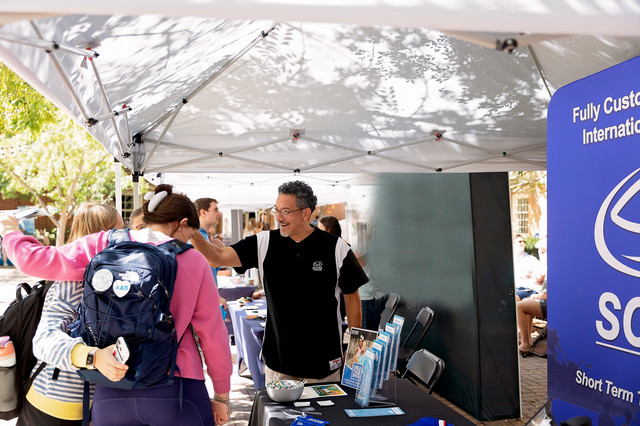
Samford University’s campus turned into a hub for global missions during the annual Go Global Week, where events challenged students and guests to spread the Gospel “to the ends of the Earth” and fulfill the Great Commission.
This year’s Go Global Week, staged Oct. 5-9, was presented by Beeson Divinity School’s Global Center and Samford’s Office of Spiritual Life.
Twenty missions agencies were hosted on campus, and lectures were delivered by J.D. Payne and Scott Moreau, who preached in Beeson’s chapel service and delivered a Global Voices lecture.
The missions agencies help students “learn what God is doing around the world and how they can join in His global mission,” said David Parks, director of the Global Center. Parks said Moreau’s sermon and lecture challenged students to “understand cross-cultural missions in ways that help us to be better missionaries.”
In his sermon, “Snapshots from Antioch,” Moreau encouraged churches to be more diverse, reminding the audience that church is more than a social gathering.
“Church is not just a social phenomenon, but a spiritual phenomenon,” Moreau said.
Jesus in Global Perspective
In his Global Voices lecture, Moreau presented illustrations of Jesus and other religious imagery from around the world as a way of contextualizing the Gospel.
“We tend to focus on thinking about faith, and we want our theology, which is a thinking exercise, to be right,” Moreau said.
However, Moreau said the Christian life, especially in other cultures, is more than just right thinking.
For African believers, for example, living the Christian life includes dancing and hearing God through dreams and visions, something that is hard to come by in American churches.
“When we examine Jesus in light of other cultures, what do we see?” Moreau said.
Moreau said seeing the artwork and other forms of faith expression in other cultures can help those serving cross-culturally to better understand those they are serving
Reaching the Unreached
In his Global Voices lecture, Payne, who serves as the Thomas Welby Bozeman Chair of Christian Ministry in the School of the Arts, discussed the challenge of thinking apostolically about the least-reached areas of the United States.
Payne recently released his research, aided by Samford undergraduate and Beeson students, that compiled information on the least-evangelical areas of the United States.
Centering his lecture on Paul’s vision of preaching the Gospel where Jesus has not been named (Rom 15:20-21), Payne called for American churches to strategically focus evangelism and church planting efforts on those areas of the U.S. most in need of a Gospel witness.
Just 23% of the U.S. identifies as evangelical, Payne said, while most of the church planting tends to be just “shuffling the sheep” already in the Kingdom.
“I’m not opposed to that, but it should be the exception, not the expectation,” Payne said.
The U.S. has 210 unreached people groups, defined as those groups whose population is less than 2% Christian, and 70 of those groups are unengaged, meaning there is no known Gospel work being done to reach them.
“There’s something missionally malignant with that,” Payne said.
Beeson’s Global Voices lectures will be available in the next few weeks on the school’s YouTube channel.