


Get Tickets
Share on:

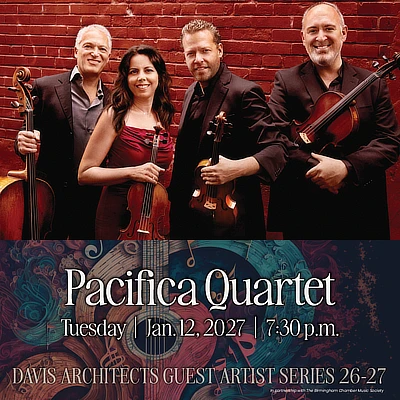
With a career spanning three decades, the multiple GRAMMY® Award-winning Pacifica Quartet has achieved international recognition as one of the finest chamber ensembles performing today. Known for delivering performances that are “engrossing, characterful…with a luminescent tranquillity [and]
spine-tingling intensity” (The New York Times), the Quartet is celebrated for its virtuosity, exuberant performance style, and fearless repertory choices. Its sound, distinguished by “warmth of phrasing, dynamic control and superbly coordinated ensemble balance” (Gramophone Magazine), has solidified the ensemble as one of the most essential voices in American chamber music.
Formed in 1994, the Pacifica Quartet quickly rose to prominence, winning chamber music’s top competitions, including the 1998 Naumburg Chamber Music Award. In 2002, the ensemble received Chamber Music America’s Cleveland Quartet Award and was named to Lincoln Center’s Bowers Program (formerly CMS Two). Four years later, it received the prestigious Avery Fisher Career Grant, affirming its position among the foremost American quartets. With its powerful energy and captivating,
cohesive sound, the Pacifica has established itself as the embodiment of the contemporary American string quartet sound. In 2026, the Pacifica received the Ruth Bader Ginsburg award from Washington Performing Arts.
An ardent advocate for living composers, the Pacifica Quartet has commissioned and premiered works by Keeril Makan, Julia Wolfe, and Shulamit Ran. Ran’s Glitter, Doom, Shards, Memory – commissioned in partnership with the Music Accord consortium, Wigmore Hall, and Tokyo’s Suntory Hall – received its New York premiere with the Chamber Music Society of Lincoln Center. In 2024, the Quartet premiered James Lee III’s Double Standard – commissioned by Carnegie Hall and Shriver Hall Concert Series – with soprano Karen Slack. Based on a poem by Frances Ellen Watkins Harper, the work was widely acclaimed for its vivid narrative power, with one critic describing the performance’s “spine-tingling intensity” (The
New York Times).
