


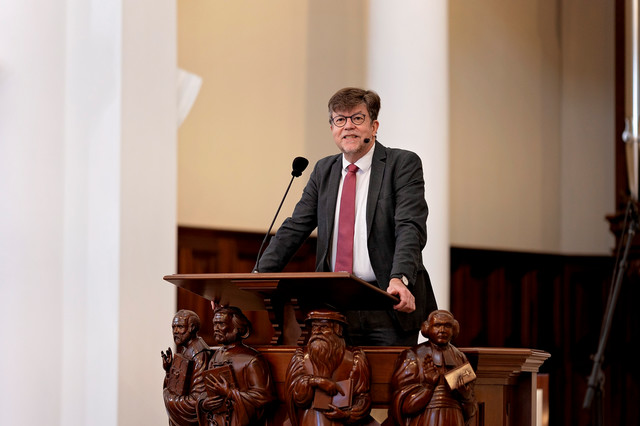
Samford University’s Beeson Divinity School welcomed Volker Leppin, Horace Tracy Pitkin Professor of Historical Theology at Yale University, who led this year’s Reformation Heritage Lectures, Oct. 27-29.
Leppin preached a sermon from Matthew 24 titled “Signs of the End,” sharing how the church throughout history has believed it is living in the end times.
“We should trust in this hope, but this should not keep us from caring for this world,” Leppin said. “When this world is destroyed, He rebuilds it and rebuilds us. Where God is, there is hope; there is faith; there is life.”
In his first lecture, Leppin talked about apocalyptic thought, purgatory and signs of the end in Martin Luther’s time.
Leppin said those in Luther’s time, anticipating that the end of time was at hand, prepared for it by seeking penance for their sins. This led to the idea of purgatory, a place of comfort, as the only exit was to heaven, and to anxiety, as the thought was a sinner would have to finish becoming clean before entering heaven.
This, Leppin said, laid the groundwork for the sale of indulgences, to reduce what one still “owed” upon their death.
“They spoke of these as a type of grace, but is grace that you pay for really a grace?” Leppin said. “It’s God’s love that gives us grace.”
The end of days, Leppin said, is a “joyful day” for true believers.
In his final lecture, Leppin dealt with the more controversial writings of Luther, mostly focused on the Jewish people, the Turks and his remarks on the German Peasants’ War in 1524-25.
In addition to his views that the papacy represented the Antichrist, Luther viewed the Jewish people as a similar enemy, intertwined with the pope, Leppin said.
“If I had not experienced my papists, I would have found it unbelievable that there could be such wicked people on Earth who would knowingly resist open and acknowledged truth—that is, God Himself—to His very face,” Luther said, speaking of the Jews and the Turks he encountered.
Leppin said some of Luther’s anger toward the Jews lies in only seeing one Jewish person converted to Christianity under his teaching. Luther eventually came to support the ruling class in the German peasant revolt, arguing it broke the peace and thus, was a greater evil than whatever problems the peasants had with those in authority. Luther would later call for the nobility to kill the peasants.
Luther’s understanding of the end times was such that he saw the papacy as the Antichrist and the revolt as the last battle, signifying all authority and order being overturned. Thus, he, like many in his time, believed he was living in the end times.
“He was full of flaws,” Leppin said. “He was right in so many respects, but he was far from being a saint.”
Leppin said Luther’s own earlier writings help him refute his later writings.
“I’ve talked about those writings of Luther I like the least, but I also wanted to show how to deal with him in this respect,” Leppin said. “We can stick to his basic insights, criticizing where he’s deferring from these insights and coming to something that’s not included in the Gospel. We can criticize him with what he himself has shown to theology.”
Later this fall, Leppin’s lectures will be available on the Beeson YouTube channel, where his sermon can be found now.