


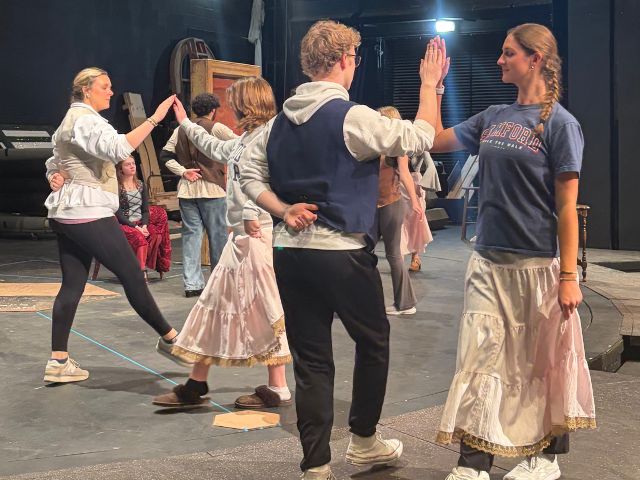
A clever servant determined to outwit his employer. A young woman navigating impossible circumstances with intelligence and grace. A nobleman unraveling as his authority slips away. A countess longing to restore a fractured relationship. A lovestruck page stumbling through adolescence.
More than 200 years after its premiere, The Marriage of Figaro continues captivating audiences because its characters feel remarkably human.
As Samford Opera prepares to present Mozart's beloved comedy, student performers are discovering the opera's enduring appeal lies not only in its beautiful music and hilarious misunderstandings, but also in the emotional depth found beneath the laughter.
For senior musical theatre major Yianni Rokas, stepping into the title role revealed a side of Figaro he did not expect.
"One thing that surprised me was just how kind and lovable he is," Rokas said. "Deep down, Figaro is very much like a puppy dog, doing his best to navigate all these situations he's getting wrapped up into."
The role has stretched Rokas as an actor. Many of his previous performances have placed him in antagonistic roles, while Figaro succeeds through charm and charisma rather than manipulation.
"This role has taught me much about stage presence," he said. "So much of the comedy is found within Figaro being so sure of himself that he screws up Susanna's tactics, not even knowing he has done so."
TICKETS: Reserve seats for The Marriage of Figaro
That dynamic is central to the story and especially evident in Figaro's relationship with Susanna, portrayed by second-year graduate vocal performance student Bianca Fasanelli ’25. Often regarded as the smartest person in the opera, Susanna spends much of the show navigating schemes and obstacles while remaining focused on her goal of marrying Figaro.
To understand the character, Fasanelli examined Susanna's relationships with every person she encounters onstage.
"When faced with the Count, Susanna is confident and clever, quickly coming up with new solutions to get what she wants," Fasanelli said. "When she's with Figaro, we get to see her be more vulnerable, her wit turning to playfulness in the presence of her betrothed whom she loves so dearly."
The role has provided significant artistic challenges as well. Susanna remains at the center of much of the opera, demanding exceptional vocal endurance.
"Susanna sings a lot," Fasanelli said.
Preparing for the role has required her to develop the stamina necessary to maintain vocal excellence from the opening scenes through the opera's final act. The experience has reinforced the importance of disciplined score study, careful vocal preparation and strategic rest.
Much of the conflict surrounding Figaro and Susanna stems from Count Almaviva, portrayed by first-year graduate music student Willian da Silva ’26. Bringing the Count to life has required da Silva to look beyond the character's flaws to understand the motivations driving his behavior.
"The key to interpreting him lies in understanding that the Count doesn't view himself as a villain," da Silva said. "He views himself as a nobleman whose authority, desires and social order are being unjustly disrespected."
Rather than portraying the Count as simply arrogant or tyrannical, da Silva found complexity in the character's insecurities.
"I believe that his arrogance and tyranny come from profound insecurity," he said.
Preparing the role also prompted him to think deeply about human nature and the contradictions Mozart builds into his characters.
"The Count is charming, cultured and elegant, but ruled by base impulses and fragile pride," da Silva said. "Preparing this role has shown me how social power blunts emotional intelligence."
One musical moment stands out for him above all others. The Count's Act III aria marks what da Silva describes as a public unraveling, revealing the character's frustration as events begin slipping beyond his control.
"While this aria is a psychological turning point for the Count, it is an athletic stretch for the performer," he said. "The core technical challenge is to keep the elegant Mozartian line while projecting his volcanic rage at the same time."
The Count's struggles are felt most acutely by his wife, the Countess, portrayed by first-year graduate vocal performance student Caroline Copeland ’25.
The Countess enters the story burdened by loneliness, struggling with the growing distance between herself and her husband. Although the circumstances differ dramatically from modern life, Copeland found points of connection with the character's emotional journey.
"I can understand hiding heavy emotions for the sake of duty," Copeland said. "She is an intelligent, dignified woman who chooses to act with grace despite heartbreak."
Bringing that emotional complexity to life has challenged Copeland to think beyond vocal technique. Mozart's recitative passages, which move the story forward through conversation-like singing, demand constant engagement with scene partners.
"I've learned that the only way a rehearsed scene can look natural is when you become present as a performer rather than just a musician," she said. "You must react in a way that's true to the character."
Copeland credits her fellow cast members with helping shape her understanding of the Countess, particularly the character's friendship with Susanna.
"She recognizes that Susanna may be the one person in her life right now that she can really trust," Copeland said. "Understanding this context helped me bring out a compassionate, more vulnerable and protective side to this character."
Another audience favorite comes in the form of Cherubino, the impulsive teenage page whose romantic daydreams repeatedly land him in trouble. Second-year graduate music student Liv Sand said the role has been a rewarding challenge.
"Cherubino has been a joy to bring to life," Sand said. "He is always getting in trouble, but has good intentions and just wants to be loved."
Known as a "pants role," a male character traditionally performed by a female singer, Cherubino requires relentless energy. Sand credits the production's staging with keeping her in constant motion.
"Cherubino's staging involves running around, crawling and jumping out of windows, and there has never been a dull moment in the rehearsal process," she said.
Beyond the physical demands, Sand has enjoyed exploring a character who approaches life with complete sincerity.
"Stepping into his shoes, I have learned how to portray someone with such honest intentions and an open heart," she said.
Although each performer has connected with a different aspect of Mozart's masterpiece, a common theme emerged from their experiences: humanity at the center of the story.
Rokas found optimism and humor in Figaro. Fasanelli discovered complexity in Susanna. Da Silva explored the contradictions and insecurities that shape the Count. Copeland connected with the Countess's resilience and compassion. Sand embraced Cherubino's sincerity and youthful exuberance.
Together, they bring to life a cast of characters whose relationships, misunderstandings, flaws and hopes feel just as recognizable today as they did in Mozart's time.
For audiences new to opera, Rokas believes The Marriage of Figaro offers an ideal introduction.
"People will come to watch this show not knowing a single thing about it, until they recognize some of Mozart's most famous tunes," he said. "You will laugh more than you thought while watching this production."
When the curtain rises, audiences will encounter much more than a classic work. They will experience the culmination of months of study, collaboration and artistic growth as Samford students bring one of opera's most enduring stories to life.
