


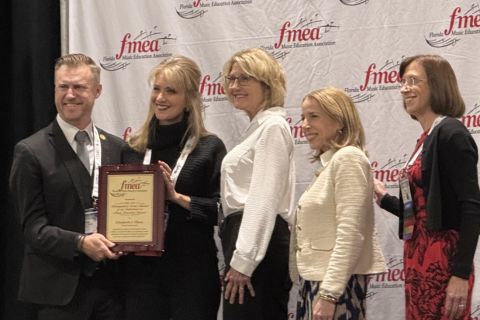
When Samford University alumna Lisa Olson ’01 talks about excellence, she does not start with accolades or awards. She starts with responsibility.
“Excellence in music education stems from an educator’s desire to continually hone their craft both as a musician and a pedagogist in order to attend to the flourishing of their students,” she said.
That philosophy, shaped during her time at Samford’s School of the Arts, has guided a career defined by teaching, advocacy and leadership. It earned her the Distinguished Service of an Individual in Music Education honor from the Florida Music Educators Association, recognizing her sustained impact on students and music programs across the state.
For Olson, the recognition reflects a calling rooted in both conviction and formation.
Formed at Samford to pursue excellence and purpose
Olson describes Samford as “a special place,” where professors model what it means to evolve and improve.
“We saw and heard our professors practicing, continually growing in their own excellence,” she said. “Their unashamed commitment to the integrity of excellence was on display for us. We saw it, we didn’tmerely hear words.”
That lived example revealed a deeper mission: developing artists who lead, serve and elevate others.
“We were given the dignity of high expectations,” Olson said. “That led to the building of tenacity and unyielding work ethic.”
She credits mentors including now retired voice professor Randall Richardson, DMA whose “steady, yet uncompromising leadership” shaped her daily discipline; music and composition theory professor Rebecca Remley, DMA who sharpened her analytical thinking; and piano instructor the late Steve Nelson, who taught that “there is no long-term reward to cutting even the tiniest corner.”
Together, she said, those experiences formed a foundation that extended far beyond performance.
From classroom to statewide advocacy
After graduating, Olson began teaching and quickly saw both the power of strong music programs and the fragility of their support.
“I saw program after program across our state being either cut entirely or harmed through partial cuts,” she said. “Those cuts were in direct opposition to my firm belief that music is curricular and every child should have access to high level musical opportunities as part of their K-12 education.”
Rather than simply lament the losses, she felt compelled to act. Her work expanded into research and advocacy, driven in part by a sense of stewardship.
“My action has been driven by the Biblical truth that ‘to whom much is given much is expected’ fits hand-in-glove with the other truth that ‘no good thing should be withheld from those who are deserving so long as it is in your power to act,’” Olson said. “These Biblical truths have endlessly fueled the pursuit of intentional, informed, and intense advocacy—especially when advocacy becomes discouraging and hard.”
Today, Olson contributes to statewide efforts to strengthen music education, helping address funding, policy and program challenges.
Why excellence matters
Olson argues that music education faces ongoing pressure as schools prioritize career readiness, sometimes at the expense of the arts.
“Schools are continually fighting the elusive goal of relevance,” she said. Yet she notes, the virtues cultivated through music—discipline, resilience, responsibility and collaboration—remain timeless. Olson also points to the role of music in building community, especially in an era marked by isolation.
“Communal participation in music has not become obsolete,” she said. “It breaks the stronghold of isolation and plays a necessary role in the well-being of students. The research is clear and compelling.”
Preparation as a way of life
Olson traces back her advocacy approach to habits formed at Samford, where meticulous preparation was expected.
“The discipline of true preparation and willing discovery through attending to each detail while developing an understanding of the whole prepared me for spending hours pursuing the understanding of how policy and legislation impact arts education at local, state, and federal levels,” she said. “Arriving prepared is one of the truest forms of courtesy.”
That mindset—attending carefully to details while understanding the bigger picture—has shaped her teaching and leadership.
A legacy of impact
At its core, Olson’s work reflects the School of the Arts’ broader mission: to cultivate artists who influence communities and serve with purpose.
“My professors taught me that no one ever regrets working hard for the right things,” she said. “Hard work, when undergirded with love, curiosity, joy and service to others, is a worthy investment.”
Receiving the Distinguished Service honor, she said, is an encouragement to continue advocating for students and programs. For Olson, the goal remains clear: ensuring that excellence in music education is not a privilege, but a possibility for every student.
