


As a child growing up in Birmingham, EJ Turner learned the power of community while sitting at his grandfather’s feet, watching the local evening news.
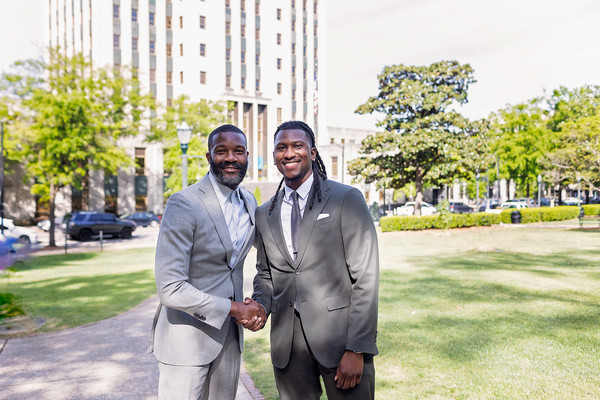
What began as quiet observation eventually turned into a call to serve—one that has guided Turner from City Hall to Cumberland School of Law and back again, completing a full-circle journey shaped by public service, legal education and a shared path with Birmingham Mayor Randall Woodfin, JD ’07, a fellow Cumberland graduate.
A Birmingham native, Turner traces his commitment to public service to those early moments at home, when local news stories revealed both the challenges and promise of the city he loves.
“That experience made me recognize the beauty and potential of my own community and eventually led me to public service,” Turner said.
That recognition became action years later during high school, when Turner interned at the Birmingham Municipal Court. There, he encountered public servants whose work would leave a lasting impression—including Judge Andre Sparks and then city prosecutor Randall Woodfin.
“Those experiences showed me what compassionate justice should look like,” Turner said. “That’s what started me down the path toward law school.”
Before enrolling at Samford University’s Cumberland School of Law, Turner joined the City of Birmingham as a full-time employee, eventually serving as executive assistant to Woodfin. The role gave him a front-row seat to municipal leadership and reinforced his belief that law could be a powerful tool for change.
“That role was like a masterclass on civic leadership,” Turner said. “I was able to see what it takes to lead a city like Birmingham, address its challenges and champion its strengths.”
When Turner arrived at Cumberland, he brought that experience with him and found a law school culture that matched his collaborative approach to service.
“One of the things I always tell people about Cumberland is that it is as competitive as any other law school,” Turner said, “but that competition does not get in the way of folks genuinely wanting to help you and be in your corner.”
That environment, he said, prepared him to return to public service in a legal capacity. Cumberland’s proximity to Birmingham’s legal community also allowed Turner to maintain relationships with attorneys and public officials committed to local impact.
“Cumberland allowed me to carry that spirit into public service as a law clerk in the city’s legal department,” he said.
Inside the classroom, Turner found coursework that deepened his interest in municipal law and expanded his understanding of how legal training intersects with public policy. Courses in municipal courts, taught by Judge Jeffrey Gilliam and Professor Tracey Roberts, as well as property and tax law, solidified his calling.
“Those courses made me realize public service doesn’t have to look one singular way,” Turner said.
Outside the classroom, Turner served as president of Cumberland’s Black Law Students Association, further strengthening his commitment to service and leadership within the legal profession.
During law school, Turner returned to the City of Birmingham as a law clerk, this time equipped with three years of legal training and a new perspective on the complexities of municipal governance.
“To be able to work with the same team that saw me grow from an intern to a full-time administrative employee, and now a law school graduate, means the world to me,” Turner said.
That growth, he said, has broadened both his skills and his sense of what’s possible in public service.
“Returning to the city with legal experience has given me the tools to understand and navigate the complexities of making our city and larger community better,” Turner said.
Following a path similar to Woodfin’s—from Cumberland School of Law to leadership in Birmingham—has only reinforced Turner’s sense of purpose.
“Servant leadership comes naturally for EJ,” Woodfin said. “He has a heart for community and a mind that's driven toward justice. His return to City Hall marks a powerful full-circle moment: his previous work here was already noteworthy, but now, sharpened by his experience with Cumberland, he’s stepping back in with clearer vision and stronger motivation. Years of preparation have led him to this moment, and we can't wait to see how he helps transform Birmingham.”
“It means a lot,” Turner said. “Cumberland is a well-respected institution in the Birmingham area, and its legal education is second to none.”
Seeing a Cumberland graduate lead the city, Turner said, affirms the role legal education plays in effective, service-driven leadership.
“Obtaining a legal education has broadened my perspective and helped me understand how important knowledge of the law is to what the mayor and his staff do day in and day out,” he said.
After graduating from Cumberland School of Law in May, Turner is eager to work in economic development and municipal finance law, areas he believes can create lasting, structural impact for Birmingham’s residents.
“Whatever capacity I serve, I want to push Birmingham closer toward realizing its true potential,” Turner said. “I want residents to experience the quality of life they deserve and for those coming behind me to achieve their dreams without feeling like they have to leave their community.”
Looking back, Turner sees his journey not as a straight line, but as a series of purposeful steps shaped by persistence and trust.
“Our journeys are not always linear,” he said. “They ebb and flow. But if you have a passion, stick to it, trust the process, and things will work out.”
For current and prospective Cumberland students interested in government or public service, Turner offers simple advice.
“If it’s your passion, don’t be afraid to give it a try,” he said. “There are so many legal and legal-adjacent careers in the public sector that need Cumberland-trained attorneys.”
For Turner, that calling—sparked years ago in a Birmingham living room—continues to guide his work, bringing his story and his service full circle.
