


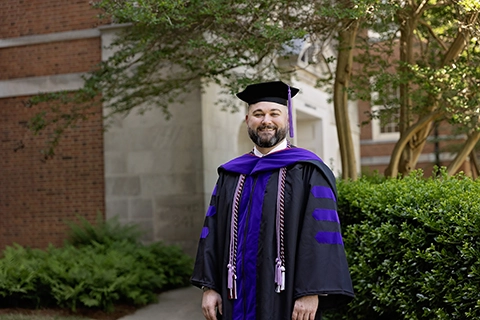
For Brady Heard, the path to law school was not a departure from community service roles but a continuation of them.
A member of Samford University Cumberland School of Law’s Class of 2026, Heard brings with him a background shaped by military service and years as a firefighter and EMT—roles defined by urgency, accountability and a commitment to others. This spring, as he prepares to graduate from Cumberland, he is stepping into a new way of serving: as a legal advocate.
But Heard’s calling began long before law school. Raised in a family dedicated to public service, he was influenced by his father, a firefighter of more than three decades, his mother, a longtime nurse, and both grandfathers, who served in the military.
“I’ve always felt compelled to step in to be the person that people can depend on when they need someone the most,” Heard said.
That sense of responsibility led him first to the United States Marine Corps, where he sought both personal growth and the opportunity to be part of something larger than himself. From there, he transitioned into firefighting, continuing a career centered on protecting others in high-stakes situations.
In each role, Heard said service meant putting others first and treating people with dignity and respect, regardless of their circumstances. The work also instilled a deep sense of accountability and preparation—lessons that would later shape his approach to legal education.
The turning point toward law came during his time as a firefighter and EMT in New York during the COVID-19 pandemic. While responding to emergencies, Heard encountered a state policy that limited how long first responders could perform life-saving measures in certain situations.
The experience left a lasting impression.
“It left me thinking about who is looking out for not only first responders and health care professionals, but every person as well,” Heard said.
Faced with that question, he began to consider how he could make a broader impact. Law, he realized, offered a new avenue to advocate for both the public and those on the front lines of service.
Transitioning from physically demanding roles into the classroom brought a new set of challenges. Where success had once been measured in physical endurance, law school required mental stamina—hours of reading, analysis and application of complex legal theories.
“It was daunting to say the least,” Heard said. “But it has been the most rewarding experience of my life to see how much I’ve grown since starting this journey.”
His background continues to shape how he approaches legal problems. Experience in crisis situations taught him to plan ahead, adapt quickly and remain steady under pressure—skills that translate directly to case analysis and advocacy.
Heard also brings a distinct perspective to the classroom, shaped by years of working with people from all walks of life.
“I feel as though I am able to find common ground with people and appreciate their perspective,” he said.
That ability, combined with what he describes as core traits of communication, camaraderie and resiliency, is part of why he believes veterans and first responders often transition successfully into legal careers.
As he prepares to graduate, Heard’s sense of purpose remains rooted in the same values that guided his earlier roles. While his work will no longer take place in emergency scenes or on the front lines, his focus on advocacy has not changed.
“The kind of lawyer I hope to become is trustworthy and dependable,” he said.
Heard plans to carry forward a strong commitment to serving others, with a particular connection to veterans and first responders, while remaining open to helping anyone in need of representation.
As he enters the legal profession, Heard defines “answering the call” much the same way he always has: showing up fully for those who depend on him.
“It means giving 110% for the needs of any person who is counting on me,” he said.
For Brady Heard, the uniform may be changing, but the mission remains the same.
