


In the military, missions are carried out with high stakes and no margin for failure.
For Samford University alumnus Billy Mann, EdD ’25, that reality felt strikingly familiar.
“Public schools have limited resources,” Mann said. “And like the military, the mission can’t fail.”
That comparison became the foundation of Mann’s dissertation, “The Role of Organizational Citizenship Behaviors for Promoting Intergenerational Professional Learning in Secondary Schools,” which earned recognition as the Orlean Beeson School of Education’s Outstanding Dissertation for the 2025–26 academic year.

Looking Beyond the Classroom
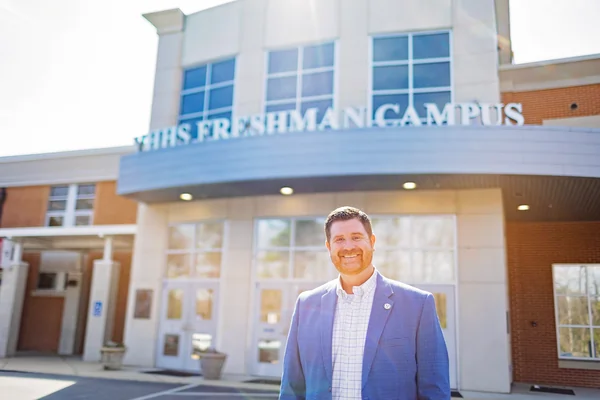
As principal at Vestavia Hills City Schools freshman campus, Mann wasn’t focused on the typical generational conversation between teachers and students. Instead, his research explored something less studied and increasingly relevant: How do teachers from different generations learn to work well with each other?
“I was interested in how Gen X, Millennial and Gen Z teachers collaborate,” Mann said. “Not just how they are different, but how those differences can actually strengthen a school.”
While generational differences in communication and teaching styles are widely acknowledged, Mann sought to understand how school leaders can intentionally foster collaboration.
That focus resonated deeply with his dissertation chair, Jane Cobia, professor and director for instructional leadership and doctoral programs, who has seen the challenge evolve over time.
“This topic is one I grappled with as a young teacher and young administrator, and there were only three generations in my workspace at that time,” Cobia said. “Now with five very distinct generations, I encouraged Bill to look for ways to help employees make connections around the common goal of student success.”
That search led him beyond education.
A Lesson from the Military
At the recommendation of Cobia, Mann began exploring leadership models in the business world and the military. He encountered the concept of organizational citizenship behavior—the idea that the most impactful contributions in an organization often happen outside formal job descriptions.
In the school context, that idea resonated immediately.
“One of the things we know is that our best teachers are always doing more than is required of them,” Mann said.
From mentoring colleagues to building relationships and fostering collaboration, these extra-role behaviors help create a culture where teachers and students thrive.
Rethinking the Generational Gap
One of Mann’s most surprising findings came during interviews with school leaders. While superintendents were quick to discuss generational differences, principals often were not.
“It’s not that principals aren’t dealing with it,” Mann explained. “They just don’t see it as generations. They see it as early-service and late-service teachers.”
That shift in perspective changes the question entirely. Instead of focusing on age-based differences, leaders can focus on experience, training and support.
“How do we meet teachers where they are,” Mann said, “and give them the tools they need to be successful?”
What Actually Makes Collaboration Work
Mann’s research ultimately pointed to a clear conclusion: effective collaboration is not about closing generational gaps. It is about building the right conditions.
Three factors consistently determined whether collaboration succeeded: trust, belonging and a shared purpose.
“When collaboration wasn’t working, it wasn’t because of age differences,” Mann said. “It was because those three things didn’t exist.”
That insight reframes a common assumption. The issue is not a 25-year-old teacher working with a 48-year-old teacher, but whether those individuals feel connected and supported within their school community.
From Theory to Practice
Mann’s findings offer practical guidance for school leaders, especially principals.
Intentional mentoring matters.
Mentorship should go beyond checklists, pairing teachers with mentors who are genuinely invested in their growth.
“Mentoring can either be good or bad,” Mann said. “It’s rarely neutral.”
Hiring shapes collaboration.
Building strong teams means hiring for personality and collaboration, not just content expertise.
“If everyone fits the same mold, you’re probably not going to have effective collaboration,” Mann said.
Relationships outweigh systems.
Even the best-designed systems depend on people to make them work.
“Everything good in your school is attached to a person,” Mann said.
A Culture Where People Want to Be
At its core, Mann’s research reinforces a simple but powerful idea: when educators feel valued and connected, schools become places whereadults and students thrive.
“If the adults enjoy being in the building,” he said, “the kids will too.”
That sense of enjoyment, rooted in trust, belonging and shared purpose, is where meaningful collaboration begins.
In a system where the mission truly cannot fail, that kind of culture is not optional.
It is essential.
