


Classrooms in Quito, Ecuador, may look different, but the heart of education remains the same. Students learning together. Teachers leading with purpose. Communities built through shared experiences.
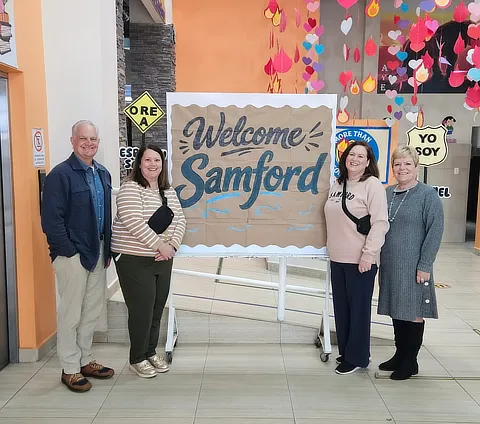
During spring break, faculty and staff from Samford University’s Orlean Beeson School of Education traveled to Quito to provide professional development for educators and school leaders, while also learning alongside them.
They partnered with three schools: El Sauce School, Alliance Academy International and Amor y Esperanza School, each offering unique opportunities for collaboration and learning.
Equipping Educators with Practical Strategies
“We incorporated a lot of hands-on, practical strategies so they could actually experience what it would be like to be a student,” said Kate Scarborough, assistant professor of teacher education.
Faculty led sessions on literacy, formative assessment, student engagement, stages of development and leadership, focusing on strategies educators could apply immediately.
“One of the main takeaways for these teachers and leaders was the use of centers or stations in the classroom,” said Kara Chism, associate professor and chair of educational leadership.
In many Ecuadorian classrooms, instruction is more traditionally structured. Introducing centers offered a new approach that encourages movement, collaboration and active participation.
“It’s a big deal for them to learn these strategies that we’ve used in America for years,” said Gena Williamson, administrative assistant.
Leadership and Community in Practice
“They all think that they have to do their own individual things to be able to lead,” said Chism. “They have rules in place because of this to keep everyone in a chain of command.”
Through leadership-focused sessions, educators explored new ways of working together.
Williamson led a personality-based activity that grouped participants into categories represented by different animals, helping them better understand their leadership styles and how they interact with others.
“When everyone sectioned off into groups based on their animals, they then had a visual representation of the different personalities among them,” said Williamson. “It created a better sense of community.”
Bill Cleveland, assistant professor of educational leadership, also led sessions on Christ-centered leadership, emphasizing leadership that models and encourages faith.
A Shared Learning Experience
“It’s easy to only think about going on these trips to help other people,” said Cleveland. “At the end of the day, we got so much more out of it than we could have imagined.”
That exchange was evident in the classrooms.
At Alliance Academy International, the team observed a student-led “wax museum” project that integrated art, science and history through authentic student work.
“I showed pictures to the students in my class here at Samford because I found the wax museum to be such a great representation of integrating art, science and technology,” said Scarborough.
For her students, it offered a clear example of student-centered learning and reinforced the importance of process over perfection.
Extending Impact Beyond the Classroom
The experience also extended back to Samford students. Teacher education sophomores created storytelling resources based on Bible stories to support English language learning at Amor y Esperanza School. In doing so, they were able to connect their coursework to a real educational need and contribute to a partnership that reaches beyond campus.
This kind of engagement reflects the School of Education’s commitment to preparing students who lead with purpose, both locally and globally.
GIVE: Support our Global Education Scholarship and help expand international opportunities for education students to educate, lead and serve around the world.