


Character education is a defining strength of Samford University's Orlean Beeson
School of Education’s mission, shaping graduates who lead with purpose, integrity and compassion. This commitment reaches beyond traditional classrooms, informing how the School of Education prepares leaders to serve their communities.
Through programs like Coaches for Character, the school is equipping athletic leaders to cultivate culture, confidence and character in the next generation of student-athletes.
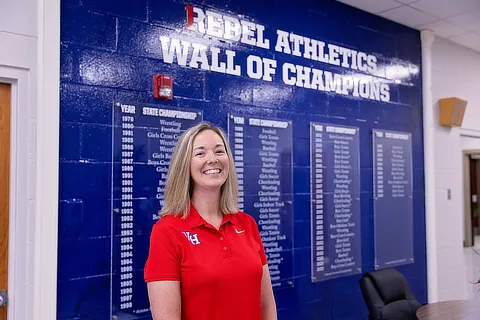
The program emerged from a shared recognition that effective coaching involves far more than technical expertise. Laura Casey, MSE ’23, director of athletics for Vestavia City Schools, believes coaches hold significant influence over school culture, student development and community well-being. Yet many coaches enter the profession with preparation focused primarily on game strategy rather than the deeper work of leadership and character formation.
“I really believe that sometimes we take young coaches and throw them in with only the X’s and O’s and not the character education piece,” Casey said. “Coaching is very little about X’s and O’s and 99% about everything else.”
Leadership That Develops People
For Casey, leadership begins with reflection and growth. Whether working with coaches or student-athletes she emphasizes asking questions such as: How are you growing? What does growth look like for you? This approach reframes success beyond wins and losses and centers leadership on developing people.
“In athletics, people look at wins and losses as a way to set a standard, but that’s not the only way,” she said. “Our job is to develop people, and the more coaches understand that, the better.”
That philosophy resonated deeply with participants in the first Coaches for Character cohort, including Katherine Terino, cross country coach at Vestavia Hills High School. As a younger coach, Terino entered the program seeking clarity on building team culture and expanding confidence in her leadership voice.
“This program helped develop my confidence as a leader,” said Terino, who also works as an assistant coach of the school’s track and field team. “Because I’m a younger coach, it’s hard to know what you can speak up about. Coaches for Character allowed me to grow in my confidence in having hard but meaningful conversations.”
Those conversations are essential to leadership that prioritizes people over performance. “I want us to be deeper than just how fast we run,” Terino told her athletes, emphasizing the importance of building a community rooted in respect and shared purpose.
A Framework for Character-Driven Coaching
Coaches for Character meets four times throughout the academic year, blending leadership theory, reflective practice and practical application. Participants explore how to articulate values, build team culture and navigate challenges while modeling integrity and accountability.
Books such as The Locker Room by Damon West and Stephen Mackey and Legacy by James Kerr provide a shared framework for discussion, prompting coaches to ask critical leadership questions: Where are we? Where do we want to be? How do we get there? These questions guide intentional team conversations and reinforce the idea that leadership is sustained through daily habits and relationships.
Jake James, varsity assistant football coach and English teacher at Vestavia Hills High School, said the program broadened his understanding of leadership by exposing him to perspectives across different sports and disciplines.
“Leadership is leadership everywhere,” James said. “Even if some aspects don’t translate exactly, you still learn from different perspectives.”
James also noted the strong connection between teaching and coaching. “Even when I’m in the classroom, I’m still coaching,” he said. “You’re managing different personalities, building trust and helping people grow.”
Shaping Coaches Who Shape Communities
Coaches for Character welcomes its third cohort of Birmingham-area coaches this year, advancing Samford’s commitment to leadership development rooted in character and service.
“Character education is foundational to developing healthy and whole adults who, in turn, create healthy and whole communities,” said Anna McEwan, dean of the School of Education. “We integrate this teaching into our curriculum and outreach endeavors like Coaches for Character because we believe it produces better graduates and serves our neighbors in a way that is uniquely Samford.”
By investing in coaches as leaders and mentors, Samford is influencing school culture and community values, demonstrating how character education can serve as a powerful foundation for leadership.
GIVE: Support character education at Samford University’s Orlean Beeson School of Education.
