


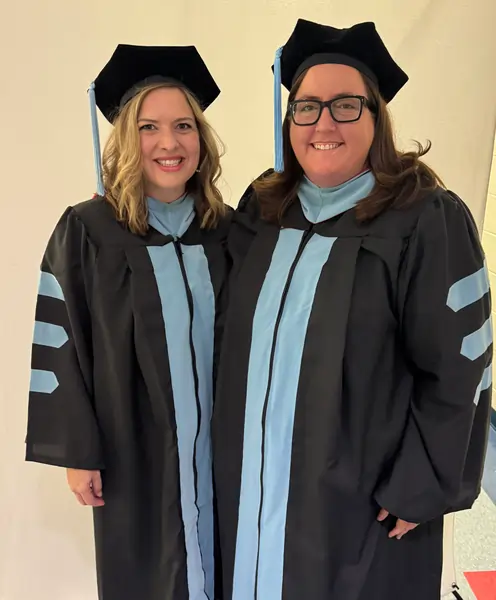
In the middle school years, when students navigate one of the most formative transitions in their education, character development can be both essential and challenging to implement. For Meghan Neil, EdD ’26, and Ann Pickens, EdD ’26, that reality shaped their doctoral research at Samford University’s Orlean Beeson School of Education.
As recent graduates of the Doctor of Education in Educational and Organizational Leadership program, their work reflects a growing emphasis on developing the whole child alongside academic achievement.
Their dissertation, focused on teacher buy-in to character education in grades 6–8, addresses a gap in existing research while offering practical insights for schools seeking to build sustainable character initiatives.
Neil, assistant principal at Bluff Park Elementary School in Hoover, Alabama, and Pickens, a social studies teacher at Vestavia Hills’ freshman campus in Vestavia, Alabama, were drawn to the topic through a shared belief in the value of character education. As they explored implementation, they noticed a consistent theme across research fields: the importance of stakeholder buy-in.
Rather than approaching the topic from the perspective of an administrator, they centered their research on teachers, the individuals responsible for bringing these initiatives to life in the classroom.
Their guiding question was simple: What helps teachers buy in to character education?
To answer it, Neil and Pickens interviewed educators across multiple states, focusing on those with 10 to 25 years of experience. These teachers witnessed the early stages of character education implementation in their schools and could speak to how it has evolved. They also concentrated on schools recognized as National Schools of Character, where successful programs were already in place.
While much of the existing research emphasizes elementary settings, middle schools remain underexplored. For Neil and Pickens, that gap was both strategic and meaningful.
“I think anyone who has ever worked with middle schoolers realizes how crucial of a transition period it is,” said Pickens. “Character education is needed because students need it at this stage.”
Through their interviews, one theme emerged clearly: teachers are deeply invested in both their students and the success of character education.
“The teachers we spoke with always brought the conversation back to students,” said Neil. “Not just how to make teachers buy in, but how to make students buy in as well.”
That perspective revealed both opportunities and challenges. Some educators noted that middle school students may perceive character initiatives as “cheesy” or too elementary. Teachers emphasized the importance of relevance by connecting lessons to real challenges students face and creating engaging, age-appropriate experiences.
At the same time, competing demands can make new initiatives feel like an added responsibility.
“Character education can feel like one more thing on a teacher’s plate,” said Pickens. “But when teachers see student buy-in and recognize the value, it helps them move past that.”
Successful programs shared several key characteristics, including shared leadership. In effective schools, administrators invited teachers into the planning process, giving them both voice and ownership.
“It was not just ‘here’s what you’re going to do,’” said Neil. “Teachers were part of the decision-making.”
Flexibility also played a critical role. Rather than relying on rigid, prepackaged curriculum, teachers adapted character education to fit their students and classrooms.
“If it’s going to feel authentic, teachers have to be able to make connections within their own curriculum and environment,” said Pickens.
Professional development emerged as another defining factor. Schools that invested in ongoing training, especially for new teachers, created stronger foundations for implementation. In Alabama, schools connected to The Hope Institute demonstrated particularly positive experiences with sustained support and training.
Teachers also reported greater buy-in when principals and administrators modeled the values they were asking others to teach.
“When leaders place a clear priority on character education and model those values, it reinforces its importance,” said Pickens.
The research highlighted the importance of extending character education beyond the classroom. When families and communities adopt the same language and values, the impact deepens.
“Utilizing these values in homes and communities allows them to grow beyond the school walls,” said Neil.
Ultimately, their work reflects a broader shift in education that recognizes the importance of developing the whole child.
“The pendulum often swings between academic focus and character development,” said Neil. “But we’re seeing a renewed emphasis on both, on preparing students not just academically, but as people.”
Their research will be presented at the School of Education’s seventh annual Character Convening this May, contributing to ongoing conversations about how schools can cultivate environments where both students and educators thrive.
For Neil and Pickens, the findings reinforce what many educators already believe: when schools intentionally foster character, they create stronger communities.
“When educators enjoy being part of a positive, values-driven environment, students feel it too,” said Neil. “At the end of the day, teachers want to help shape not just learners, but good humans for the future.”
